Somewhere in Japan, on a hillside or a riverbed, there is clay that has not yet become anything. It has no shape, no history, no name. Everything covered in this series — shapes and feet, wheels and paddles, glaze and ash and fire — starts here, in ground that looks like nothing in particular. This final guide follows a single piece through that whole distance: from unremarkable earth to a bowl someone eventually holds in both hands.
Earth
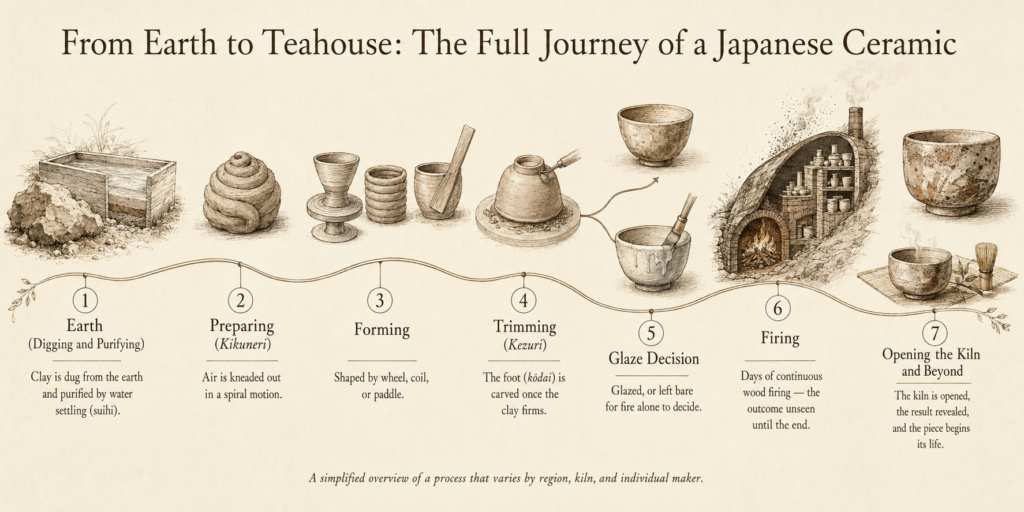
A potter, or someone working on a potter’s behalf, digs the clay directly from the ground — a hillside in Shigaraki flecked with feldspar, a riverbed in Bizen dense with iron, a quarry in Arita where the material isn’t clay at all yet but stone, waiting to be crushed into something workable. Whatever this material becomes later, it starts as geology, not craft.
Raw clay arrives full of things that don’t belong in a finished vessel: pebbles, root fragments, air. Suihi, the water-purification process described earlier in this series, separates what’s usable from what isn’t — clay stirred into water until it becomes a loose slurry, left to settle, skimmed at exactly the moment when the coarse material has sunk and the fine clay is still suspended. Some traditions purify more aggressively than others; Shigaraki and Iga deliberately leave in some of the grit that suihi would remove, since that texture becomes part of the finished piece’s character. Either way, before anything is thrown or shaped, the clay has already been edited once.
Then comes kikuneri, the kneading that removes trapped air — a physically demanding, almost meditative motion that leaves behind a spiral, folded pattern in the clay, named for its resemblance to a chrysanthemum. Every apprentice learns this before touching a wheel, because air left inside a piece doesn’t disappear. It waits, and it can crack or shatter a piece days later, in the kiln, when there’s no way to fix it.
Form
Only now does the clay become a shape. A potter centers it on a wheel — electric or the older foot-powered kind, each leaving its own subtle signature in the piece — and draws it upward and outward into a chawan, a guinomi, a jar. Or the clay is built instead: coiled rope by rope into a form too large for a wheel, or paddled from coils using tataki, the technique that shaped so many of Karatsu’s and Bizen’s older jars, or pinched directly by hand into something that will never pretend to be perfectly symmetrical.
Whichever technique is used, a decision is being made in real time about how much of the potter’s own hand should remain visible in the final object. A kick wheel’s natural, slightly uneven rotation, left uncorrected, becomes part of a piece’s character rather than a flaw to smooth away. A hand-built bowl’s asymmetry is the whole point, not an accident tolerated around it. Nothing here is neutral.
Once a form is roughly right, it dries to a leather-hard state — firm enough to carve, still soft enough to shape — and kezuri, trimming, begins. This is where the kōdai is actually carved into existence: first the foot and its surrounding area, establishing the base the whole piece will stand on; then the mikomi, the interior floor, refined once the exterior proportions are settled; and last, the kōdai-uchi, the inside of the foot, where a maker decides — based on everything the piece has become by this point — whether to leave it plain or carve in a tokin, the small spiral nub some Ido-style bowls carry as a quiet, almost private detail nobody sees unless they turn the bowl over.
Fire, or Not Yet
Before firing, one more decision has to be made, and it’s the largest one in this entire process: will this piece be glazed, or will it be left bare, its final surface decided entirely by clay and flame?
If it will be glazed, a jinkō-yū — Shino’s milky feldspathic white, Oribe’s confident copper green, Kiseto’s pale, quietly accented yellow-brown, Tenmoku’s near-black iron glaze — is mixed, and brushed, poured, or dipped onto the piece. If it won’t be, nothing further happens to the surface at all. The clay goes into the kiln exactly as it left the trimming stage, and everything that happens to it from this point forward will be decided by ash, flame, and time rather than by the potter’s hand.
Either way, the piece is now ready for the part of the process no one — not the most experienced kiln-master alive — can fully predict.
The Kiln
The piece is loaded into an anagama, a single sloped tunnel dug into a hillside, or a noborigama, several connected chambers climbing a slope, each one passing heat upward into the next. Placement inside the kiln matters enormously and is chosen deliberately: closer to the firebox for pieces meant to catch heavier ash and more dramatic effects, further along for pieces meant to fire more evenly and gently. Some pieces are wrapped in straw first, so that where the straw touches, hidasuki — reddish fire-cord markings — will be burned permanently into the surface.
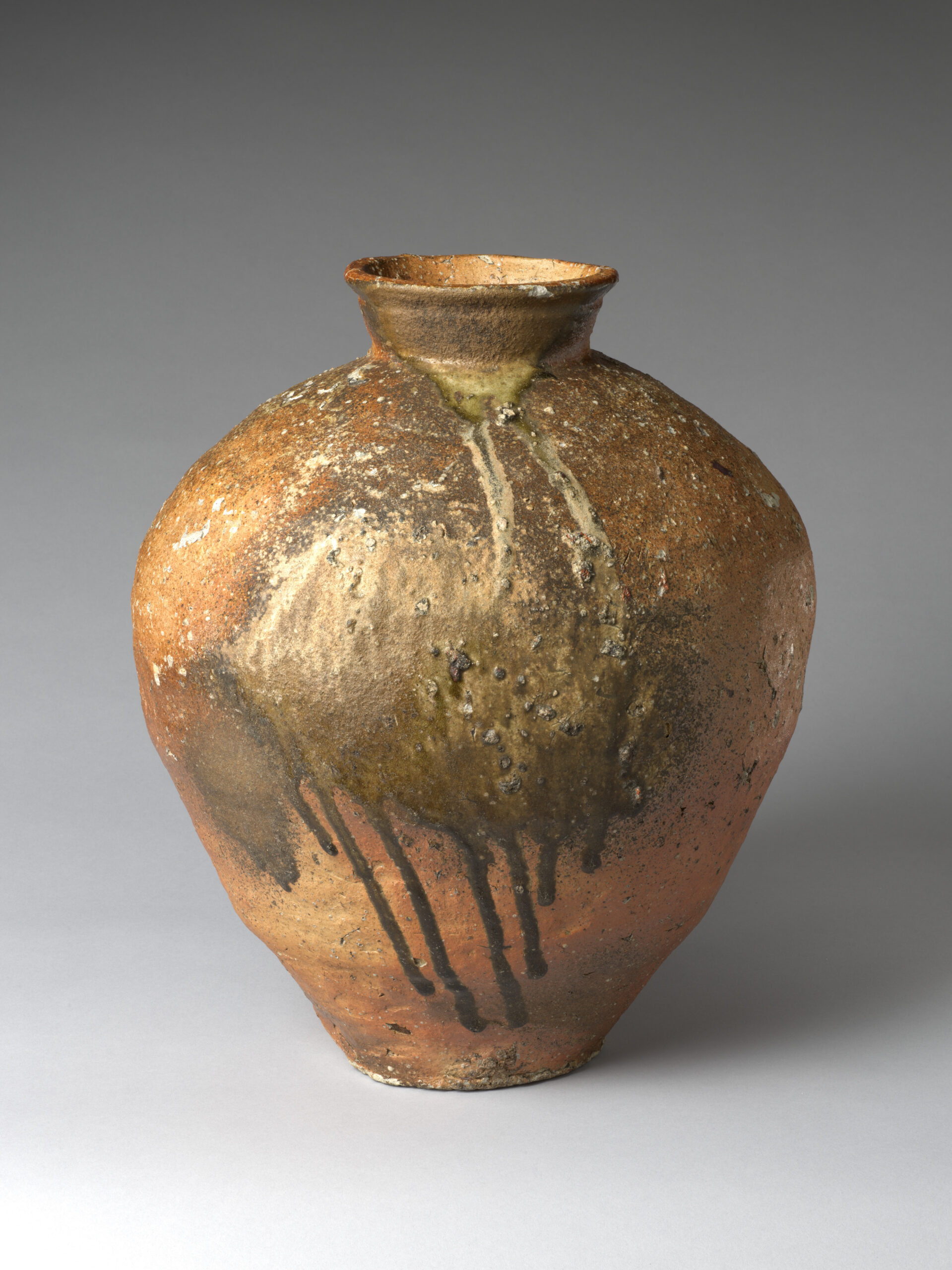
Then the firing begins, and for wood-fired traditions, it does not stop for days — sometimes more than a week, wood fed continuously, temperature built and sustained by hand through shifts of exhausted, soot-covered people who barely sleep. Nobody firing an anagama or noborigama can see inside while this is happening. They’re managing temperature, airflow, and timing from the outside, based on experience and instinct, while the actual transformation — clay hardening into stoneware, ash melting into goma flecks and sangiri patches and bidoro’s glassy green pools — happens completely out of sight.
This is the moment every term introduced earlier in this series was actually leading toward. Not a glossary entry, but hours inside a sealed, burning chamber where a specific piece of clay is being changed by heat in ways nobody, including the person who made it, can fully see or control while it’s happening.
Opening the Kiln
When the fire is finally allowed to die down and the kiln cools enough to open — sometimes days after the last log was added — the result is revealed all at once. This moment carries real weight in every wood-firing tradition in Japan, because it’s the first time anyone actually sees what happened. A piece expected to turn out well can emerge disappointing. A piece given little special attention can come out extraordinary, marked with an unrepeatable pattern of goma or hidasuki or bidoro that no one, least of all the potter, specifically asked for.
This is where the philosophy running underneath this entire series stops being an abstract idea and becomes a physical fact sitting in someone’s hands: depth over decoration, chosen for the work itself rather than for a story imposed on it afterward. Nobody decorated this piece to look this way. The kiln did.
Into the World
From here, a piece is sorted — kept, or set aside if the firing simply didn’t work in its favor, since not every piece survives days inside a kiln in a state worth keeping. What remains gets a final look, sometimes years of consideration before it ever reaches a collector’s hands, and then it travels: from a workshop in Tobe or Bizen or Hagi, into a box, onto a shelf, eventually into daily use or careful display somewhere else in the world entirely.
And for some pieces, the story doesn’t end there either. A Hagi chawan used for tea over years slowly absorbs moisture through its kannyū crackle, shifting color a little more with each use — the seven transformations collectors watch for. A well-loved piece eventually gets kintsugi repair if it breaks, its damage rejoined with lacquer and gold rather than hidden, becoming, in its own way, a second firing’s worth of history layered onto the first.
None of this — the digging, the kneading, the wheel or the paddle, the days inside a burning kiln, the years of use afterward — is decoration applied to an object after the fact. It’s the object. A finished chawan isn’t a design that happened to be made from clay. It’s the physical record of everything that happened to a specific handful of earth, on a specific hillside, on its way to becoming something someone, somewhere, chooses to hold.
About HOJO Japanese Ceramics
HOJO Japanese Ceramics is based in Tobe Town, Ehime Prefecture, one of Japan’s historic pottery regions.
We research, curate, and share authentic Japanese ceramics with collectors around the world.
Explore our curated collection in the HOJO Etsy Shop.