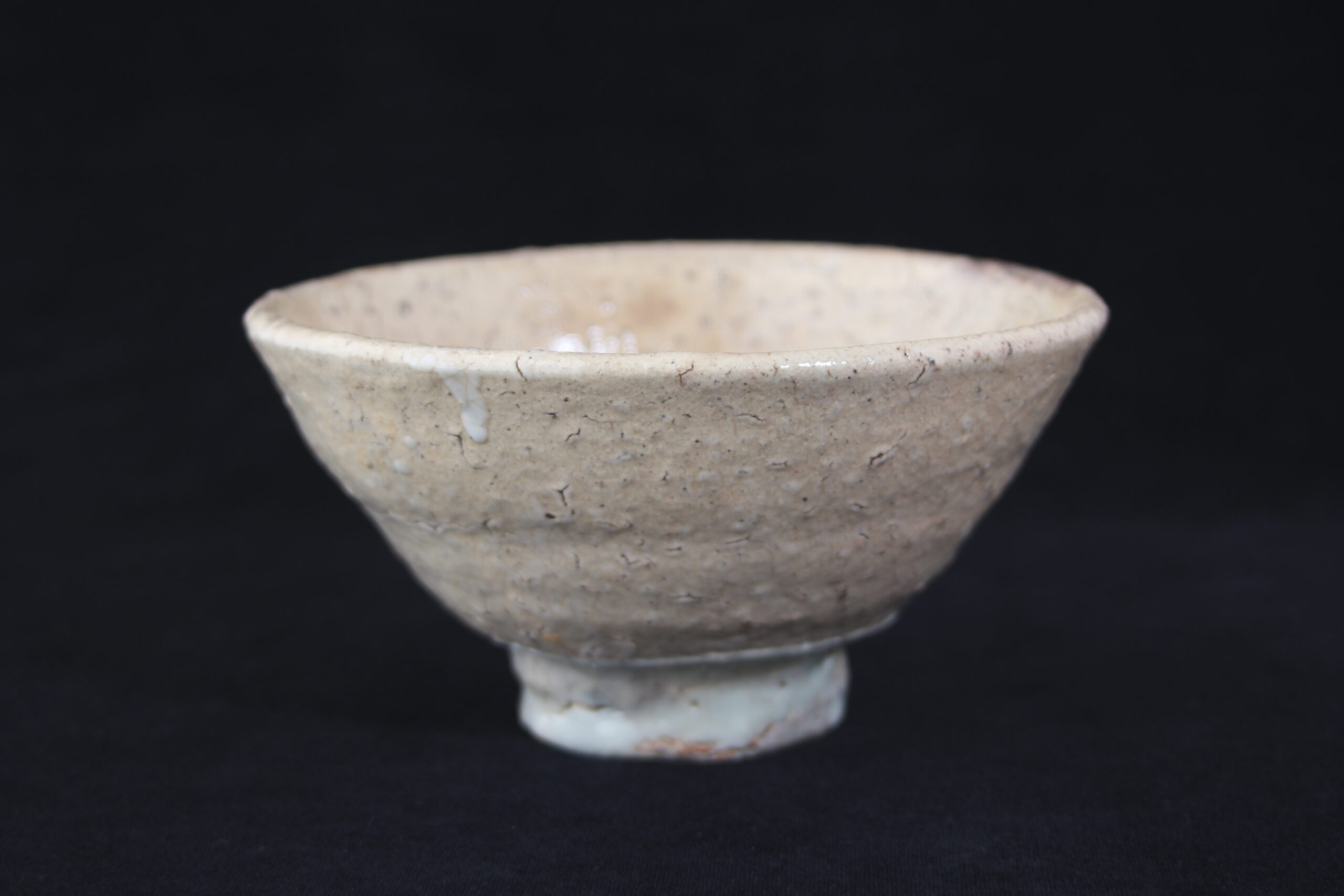
A Hagi chawan bought new looks almost deceptively plain: a soft, pale glaze, a warm but understated surface, nothing that announces itself. Give that same bowl ten years of actual use — tea poured into it regularly, the glaze’s fine network of cracks slowly taking on color from what passes through them — and it will look like a different object. This is not a bowl that arrives finished. It’s a bowl that starts a very slow process the day it leaves the kiln, and Hagi ware’s entire reputation rests on collectors and tea practitioners who value exactly that.
This guide goes deeper into Hagi than the overview in our regional pottery guide: the specific history of two Korean potter lineages that shaped it, the mechanism behind its famous transformation over time, and what to actually look for when evaluating a piece.
Two Lineages, One Origin
Hagi ware’s origin is unusually well documented for a ceramic tradition this old, because it’s tied to a specific political event. In 1604, the daimyo Mōri Terumoto, recently reduced in territory after his defeat at the Battle of Sekigahara, relocated his domain’s base to Hagi. Among the people who came with him were two Korean potters, brothers Yi Sak-gwang and Yi Kyung, recruited during Toyotomi Hideyoshi’s Korean campaigns of the 1590s from Gyeryongsan, one of the most important kiln regions of the Korean Joseon dynasty. Terumoto established an official domain kiln (goyōgama) for them at Matsumoto, on the outskirts of Hagi castle town.
The earliest Hagi ware closely followed Korean Goryeo-style tea bowls in both technique and form — understandable, given that the potters making it had trained in Korea, not Japan. Ware from the first three generations of Yi Kyung’s family line, who took the Japanese name Saka, is known as Ko-Hagi (“old Hagi”) and is considered the tradition’s golden age.
The two brothers’ descendants eventually split into genuinely separate lineages. Yi Sak-gwang’s line, under the Yamamura family name, continued leading the Matsumoto kiln through the mid-seventeenth century, until in 1657 Yamamura Mitsutoshi — Yi Sak-gwang’s grandson — relocated with his disciples to Fukawa, in what’s now Nagato City, and established a second official kiln with a distinctive semi-official, semi-private status, giving it looser ties to the main domain and closer relationships with surrounding sub-domains. His family later took the name Sakakura, the lineage that produces Hagi ware’s Sakakura Shinbei kiln today.
Back at Matsumoto, Yi Kyung’s descendants continued as the Saka family, and in 1663 two more craftsmen joined the workshop as officially employed potters: the first-generation Saeki Hanroku and the first-generation Miwa Kyūsetsu. Miwa’s arrival mattered beyond just adding capacity — he introduced Raku-ware techniques into Hagi production, broadening it past strict Korean-style forms to include Oribe-influenced shapes and a more distinctly Japanese design sensibility, the beginning of Hagi ware developing its own identity rather than simply continuing Korean tradition.
The founding Yamamura lineage didn’t survive intact. In 1774, an adopted heir to the family was involved in a blade-related scandal serious enough to cost the family its stipend and official standing, ending the direct line from Yi Sak-gwang after roughly a century and a half. Production at Fukawa continued under other families, but the specific bloodline considered the tradition’s founding lineage effectively ended there — a detail worth knowing precisely because so much of Hagi’s later marketing emphasizes continuous lineage, and this is the one significant break in that story.
Hagi ware struggled, like many domain-sponsored crafts, after the Meiji Restoration dissolved the feudal system that had funded it. Individual, commercially run kilns replaced the old official workshop, and quality was inconsistent for decades. Two developments mark its twentieth-century recovery: Miwa Kyūwa (the tenth-generation Miwa Kyūsetsu, 1895–1983) developed a distinctive thick, textured white glaze known as Kyūsetsu-jiro (“Kyūsetsu white”), recognized as an Important Intangible Cultural Property holder in 1970; and the twelfth-generation Sakakura Shinbei is specifically credited with reviving Hagi ware’s national reputation after a period of decline, earning him recognition as a Selected Intangible Cultural Property holder in 1957. Hagi ware received formal Traditional Craft designation from Japan’s Ministry of Economy, Trade and Industry in 2002.
What Actually Defines Hagi
Hagi’s material identity comes down to one specific clay source: Daidō clay, a soft white clay from Hōfu, elsewhere in Yamaguchi Prefecture. This clay fires to a porous, relatively soft body — softer and more absorbent than most other Japanese stoneware — covered in a thin, semi-translucent feldspathic glaze. That combination of porous body and thin glaze is the entire mechanism behind everything Hagi ware is known for.
Kannyū and the Seven Transformations
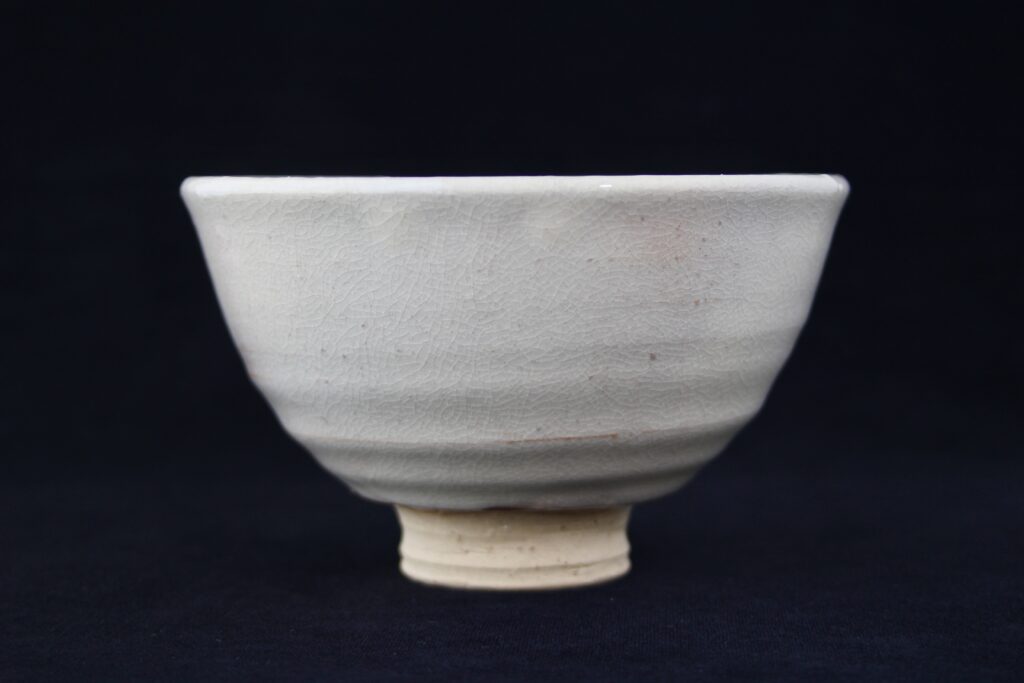
Because the glaze and clay body cool and contract at slightly different rates after firing, Hagi ware develops fine surface cracks called kannyū — present from the moment a piece leaves the kiln, visible but essentially colorless at first. What happens next is what makes Hagi genuinely distinctive: because the body beneath that thin glaze is porous, tea, moisture, and the residue of repeated use gradually seep into those cracks over months and years of actual use, slowly darkening and shifting the bowl’s overall color and surface character.
This gradual transformation has a specific name in Japanese tea culture: Hagi no nanabake, “the seven transformations of Hagi” — a traditional way of describing how dramatically a well-used bowl’s appearance can shift compared to when it was new. It’s not a defect being tolerated. It’s the entire premise of collecting Hagi ware in the first place: a bowl bought new is understood to be unfinished, in the sense that its most interesting phase hasn’t happened yet.
This mechanism is worth connecting directly to ideas covered elsewhere on this site. Where kintsugi treats a specific, sudden event — breakage — as worth making visible rather than hiding, Hagi’s kannyū treats a slow, ongoing process — years of use — the same way. Both refuse to separate an object’s present appearance from its actual history.
Notable Lineages
Two family lines dominate serious discussion of historical and contemporary Hagi ware, both traceable back to the seventeenth century.
The Miwa family descends from the first-generation Miwa Kyūsetsu who joined the Matsumoto kiln in 1663. The tenth-generation Miwa Kyūsetsu (Miwa Kyūwa) developed the Kyūsetsu-jiro white glaze style and was recognized as an Important Intangible Cultural Property holder in 1970; the eleventh-generation Miwa Kyūsetsu (Miwa Jusetsu) received Living National Treasure designation in 1983. Two Living National Treasures from the same family lineage, within a single generation of each other, is a genuinely unusual concentration even among Japan’s major ceramic traditions.
The Sakakura family, descended from Yamamura Mitsutoshi’s relocation to Fukawa in 1657, continues today at what’s generally described as the fifteenth generation, with the twelfth-generation Sakakura Shinbei specifically credited with Hagi ware’s twentieth-century national revival.
Beyond these two lines, the Saka family (descended from Yi Kyung, under the name Saka Kōraizaemon) continues at Matsumoto, and a substantial number of independent kilns — in both Matsumoto and Fukawa, plus workshops in Yamaguchi City — produce Hagi ware today without claiming direct descent from either founding lineage. As with any attribution, a workshop’s actual documented lineage should be confirmed against real evidence rather than assumed from a kiln’s location or general reputation.
Typical Forms
Hagi ware is overwhelmingly associated with chawan — more so than almost any other Japanese ceramic tradition, a direct consequence of its origin as tea ware for a daimyo’s official kiln and its traditional ranking (ichi Raku, ni Hagi, san Karatsu — “first Raku, second Hagi, third Karatsu”) among ceramics prized for tea. Mizusashi (fresh water jars) and hanaire (flower vases) are also produced, along with a smaller range of everyday tableware, but the tea bowl remains Hagi’s defining form in a way that isn’t true of most other regions covered elsewhere on this site.
A Collector’s Guide to Hagi
A few practical points worth keeping in mind when evaluating a piece:
Genuine kannyū development takes real time, and that matters for how a piece should be described. A crackle pattern that’s colored evenly and uniformly, without variation, is worth a closer look — genuine aging through use tends to develop unevenly, following wherever tea and handling actually reached the bowl most, not in a perfectly consistent pattern across the whole surface. Be cautious of any piece marketed with claims of dramatic “nanabake” coloring that seems disproportionate to its stated age or documented use history.
Daidō clay’s soft, porous character is part of genuine Hagi ware, not a manufacturing flaw. A Hagi piece that feels notably lighter and more porous than a harder stoneware body from another region is behaving as expected, not showing a defect — though this same softness means Hagi ware is generally more prone to staining and should be handled with that in mind.
Lineage claims for Miwa or Sakakura workshops deserve the same evidence standard as any attribution. Given how much of Hagi’s reputation is built around two specific, well-documented family lines, a piece attributed to either lineage should come with real supporting documentation — a signed tomobako, a clear chain of provenance — rather than resting on the general prestige of the names alone.
The 1774 break in the founding Yamamura lineage is worth knowing precisely because it’s often glossed over. Continuous production at Fukawa since the seventeenth century is genuine and well documented, but “continuous production” and “unbroken bloodline from Yi Sak-gwang” are two different claims, and only the first one is actually accurate past 1774.
Why Hagi Rewards Patience
Most of the ceramic traditions covered on this site reveal their character the moment a kiln opens — the ash effects are fixed, the glaze has set, what you see is largely what you’ll keep seeing. Hagi ware asks for something different: patience measured in years, not days. A bowl’s most interesting version of itself doesn’t exist yet when you buy it. It’s still being written, one cup of tea at a time, by whoever chooses to actually use it.
About HOJO Japanese Ceramic
HOJO Japanese Ceramics is based in Tobe Town, Ehime Prefecture, one of Japan’s historic pottery regions.
We research, curate, and share authentic Japanese ceramics with collectors around the world.
Explore our curated collection in the HOJO Etsy Shop.