Every other origin story in this series involves something dramatic: a tea master’s specific commission, a Korean potter’s discovered kaolin deposit, a domain lord’s cultural ambition. Tobe ware, HOJO’s own home tradition, began with something considerably less romantic: a cash-strapped domain trying to figure out what to do with a pile of industrial waste. That unglamorous beginning turns out to explain almost everything about what Tobe ware actually is — and why it’s worth taking seriously on its own terms rather than by the standards of more decorative traditions
- A Whetstone Town Before It Was a Porcelain Town
- Porcelain From a Pile of Waste
- The Raw Material Revolution
- From Local Ware to Export Good
- What Actually Defines Tobe Ware Today
- The Mingei Connection
- Notable Kilns
- A Collector’s Guide to Tobe
- Why Tobe Rewards a Different Kind of Respect
- About HOJO Japanese Ceramic
A Whetstone Town Before It Was a Porcelain Town
Tobe’s relationship with stone predates its porcelain by well over a thousand years. The area was known from ancient times for Iyo-to, a whetstone quarried locally and valued highly enough that surviving Nara-period temple records reportedly mention Tobe whetstones being used in the construction of Tōdaiji. Ceramic production of a much humbler kind arrived earlier than most people realize, too: Korean potters brought to Japan around the Keichō era (1596–1615) are said to have produced everyday stoneware — sake bottles, plates, bowls — in the area for ordinary local use. A 1740 domain document, the Ōzu Hiroku, already refers to bowls made at Kitakawage and Ōminami as “Tobe-yaki,” meaning the name itself predates Tobe’s porcelain industry by nearly four decades.
Porcelain From a Pile of Waste
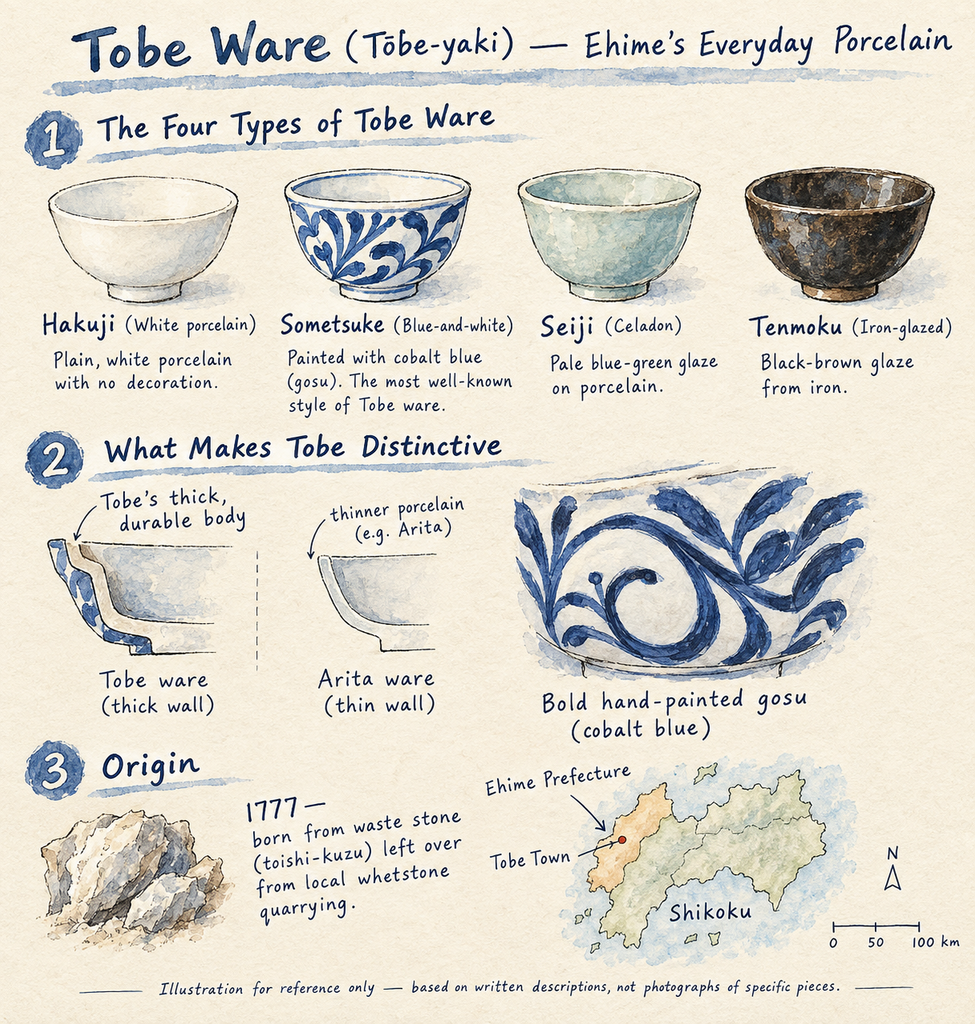
The porcelain tradition most people mean by “Tobe ware” today has a distinctly practical origin. By the 1770s, the Ōzu domain, which governed Tobe, was in real financial difficulty. Someone — accounts credit a merchant’s suggestion — pointed out that the substantial waste generated from whetstone quarrying (toishi-kuzu) might be usable as raw material for porcelain, effectively turning an industrial byproduct into a new source of domain revenue. In 1775, the ninth Ōzu lord, Katō Yasutoki, ordered his retainer Monden Kinji and a craftsman named Sugino Jōsuke to make it work.
It did not work easily. Repeated attempts at firing produced pieces that cracked badly, a problem eventually traced to the glaze rather than the clay body itself. Sugino Jōsuke, reportedly spending down his own personal resources to keep the effort going, searched as far as Chikuzen in Kyushu for better glaze materials. After roughly two and a half years of failure, in 1777, the effort finally succeeded: white porcelain with hand-painted indigo decoration, fired successfully for the first time. That date — 1777, Anei 6 — is now treated as Tobe porcelain’s official founding year, marked with a bicentennial celebration across the town in 1977.
The Raw Material Revolution
Early Tobe porcelain wasn’t especially white. The whetstone waste it was made from carried enough iron content to give pieces a slightly grey cast compared to what Arita, drawing on purer kaolin deposits, could produce. That changed in 1818, when Mukai Genji discovered a new porcelain stone deposit at Kawanobori, with a much lower iron content. The shift from whetstone-waste clay to Kawanobori stone is generally described in local histories as a genuine “raw material revolution” for Tobe ware — the point at which its porcelain started looking like the bright, clean white body associated with the tradition today, rather than the duller grey-white of its first four decades.
Technical development continued through the nineteenth century on several fronts: glaze supply stabilized once Sugino Jōsuke located usable glaze stone locally at Miaki, sparing the workshop dependence on distant Chikuzen sources; Kameya Kurazō traveled to Hizen — the Arita region — under domain orders specifically to study nishiki-e overglaze painting technique, a direct technology transfer from Japan’s most established porcelain center, echoing the way Kutani’s own founder had trained in Arita over a century earlier; and various potters introduced practical improvements to kiln construction and bisque-firing methods through the 1840s and 1850s.
From Local Ware to Export Good
Tobe ware’s shift from a regional product to something distributed nationally is tied to a specifically post-feudal development. Before the Meiji Restoration abolished Japan’s domain system, Tobe (under Ōzu domain) and the nearby port town of Matsumae (under the separate Matsuyama domain) had little commercial contact despite their proximity, simply because they answered to different feudal authorities. Once domain boundaries stopped mattering administratively, around 1872, Matsumae merchants — already running coastal trading ships — began carrying Tobe ware to markets across Japan, a distribution channel that plainly wouldn’t have opened under the old system.
International trade followed. Tobe ware reached Qing-dynasty China by 1885, and was later exported under the name “Iyo Bōru” (“Iyo bowl,” after Ehime’s historical name Iyo) to Southeast Asian markets. Perhaps the tradition’s single most notable international recognition came in 1893, when a pale yellow porcelain glaze called tan’ōji, developed by the potter Mukai Wahei just three years earlier, won first prize at the World’s Columbian Exposition in Chicago — a genuinely significant achievement for a porcelain tradition that, at the time, was barely a century removed from being a domain’s attempt to monetize whetstone scraps.
What Actually Defines Tobe Ware Today
Modern Tobe porcelain is defined by a specific combination of practical and visual qualities. The body is thick-walled and noticeably heavier than Arita or Kutani porcelain, a direct consequence of the local stone’s mineral character, and this thickness is functional rather than accidental: it makes finished pieces genuinely more resistant to cracking and chipping than thinner porcelain, better at holding heat, and comfortable to handle even filled with something hot — durability that Tobe ware has been marketed on honestly for well over a century, because it happens to be true.
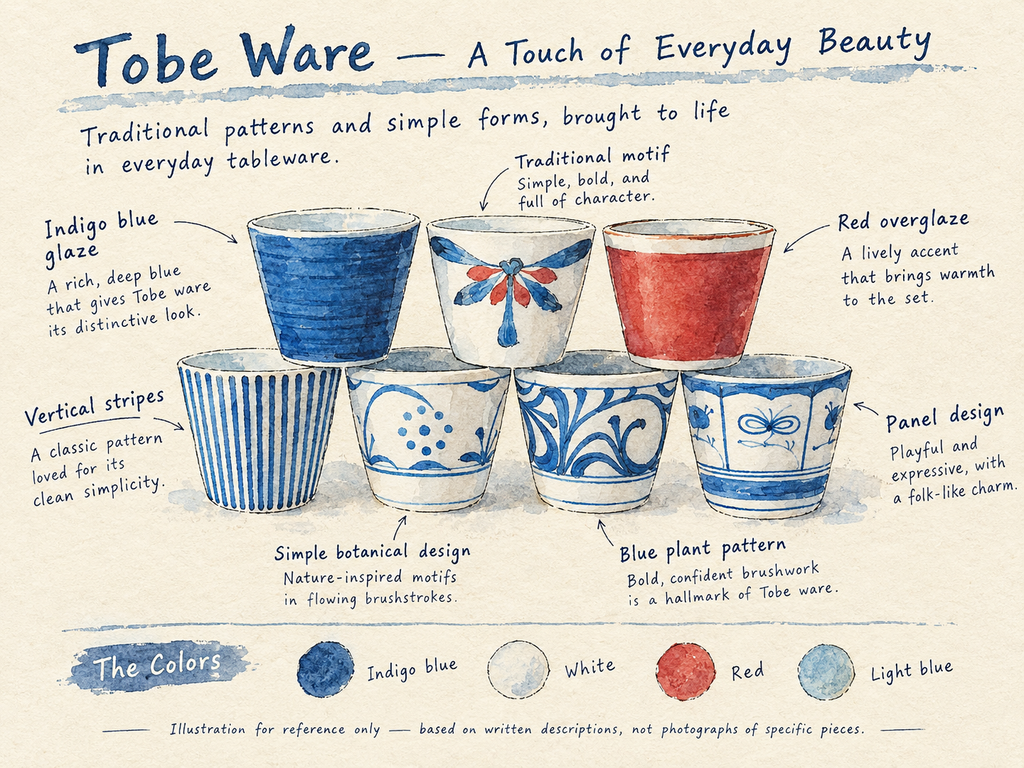
The visual signature is bold, hand-painted cobalt-blue (gosu) decoration — loose, confident botanical and abstract patterns brushed directly onto the slightly bluish-white body, prioritizing everyday charm over the fine, controlled detail of Kakiemon-style overglaze work. Individual kilns and even individual pieces show real variety within this general approach — stripes, simple floral motifs, arabesque scrollwork, occasional red accent overglaze — a reminder that “Tobe ware” covers a genuine range of everyday hand-painted decoration rather than one fixed pattern.
It’s worth knowing that blue-and-white sometsuke decoration, while the style most associated with Tobe internationally, is only one of four categories of Tobe ware formally recognized under Japan’s national Traditional Craft designation — the other three being plain white porcelain (hakuji), celadon (seiji), and iron-glazed tenmoku ware, a broader technical range than Tobe’s popular reputation usually suggests.
Tobe ware received formal Traditional Craft designation from what’s now the Ministry of Economy, Trade and Industry in December 1976 — the sixth ceramic tradition in Japan to receive this designation nationally — and was further recognized as an Ehime Prefecture Intangible Cultural Property in 2005.
The Mingei Connection
Tobe ware’s plain functionality found renewed appreciation in the twentieth century through Japan’s mingei (folk craft) movement. Philosopher Yanagi Sōetsu and the British potter Bernard Leach both visited the region, part of the same broader mingei validation that elevated Onta, Tamba, and other utilitarian ware traditions from “merely functional” to “functional and therefore beautiful” in the movement’s own terms. The potter Tomimoto Kenkichi’s visits in the mid-1950s are credited with encouraging local kilns toward more deliberate design sensibility, building on — rather than replacing — the tradition’s existing practical character.
Notable Kilns
Long-established workshops including Baizan Kiln and Ryūsen Kiln continue producing hand-painted Tobe tableware using techniques with a documented lineage back through the Edo period, alongside a substantial number of independent contemporary kilns and individual potters — Tobe’s Wikipedia entry notes recognized skilled craftspeople and roughly a hundred active workshops producing work across a genuine range of individual styles, well beyond the single blue-and-white image most outsiders associate with the name.
One workshop worth knowing individually is Hakusui Kiln (白水窯), founded by the first-generation Yamada Hakusui and continued today by his son, the second-generation Yamada Hakusui (given name Kunio, born 1944), who trained under his father from 1973, took the workshop name in 1984, and later served as director of the Tobe Pottery Traditional Industry Hall. According to accounts passed down with individual pieces and their tomobako, the first-generation Hakusui is said to have been recognized as an Intangible Cultural Asset holder for Tobe Town and to have had work presented to members of the Japanese Imperial Household — claims worth treating as attributed history tied to specific documented pieces rather than independently confirmed biographical fact, in keeping with this guide’s general approach to attribution.
A Collector’s Guide to Tobe
A few practical points worth keeping in mind when evaluating a piece:
Tobe ware’s value proposition is genuine daily use, not rarefied display. Unlike Bizen guinomi or Hagi chawan, which trade partly on scarcity and individual artistic reputation, Tobe ware’s core appeal has always been sturdy, honestly priced, hand-painted tableware. A piece described in language suggesting rarefied museum-grade status, disconnected from this practical heritage, is worth a second look.
“Sometsuke” isn’t the whole story. Given that white porcelain, celadon, and tenmoku are equally recognized under Tobe’s own Traditional Craft designation, a collector interested in the fuller range of the tradition shouldn’t assume every genuine Tobe piece will show the blue-and-white decoration most associated with the name internationally.
The 1818 Kawanobori shift is a useful rough dating tool. Pieces made from the earlier, iron-heavier whetstone-waste clay will show a visibly greyer body than post-1818 work using Kawanobori stone — a detail worth checking against any claim of especially early production.
Weight and thickness are actual quality indicators here, not just a rustic aesthetic. Because durability is a documented, intentional feature of the tradition rather than an incidental style choice, a Tobe piece that feels unusually thin or fragile for its type is behaving atypically for the ware, which is worth noting when evaluating condition or authenticity.
Why Tobe Rewards a Different Kind of Respect
Nothing about Tobe ware asks to be read the way Bizen’s ash effects or Kutani’s five colors ask to be read — there’s no dramatic firing accident to decode, no centuries-old court commission behind it. What Tobe offers instead is a genuinely honest object: porcelain that exists because a struggling domain needed a way to turn quarry waste into something useful, refined over two and a half centuries into thick, dependable, hand-painted tableware that does exactly what it was built to do. For HOJO, based in this same town, that unglamorous origin isn’t a limitation to work around. It’s the same principle — choosing the work itself, not the reputation behind it — that this entire site is built on, playing out in the most literal, local way possible.
About HOJO Japanese Ceramic
HOJO Japanese Ceramics is based in Tobe Town, Ehime Prefecture, one of Japan’s historic pottery regions.
We research, curate, and share authentic Japanese ceramics with collectors around the world.
Explore our curated collection in the HOJO Etsy Shop.