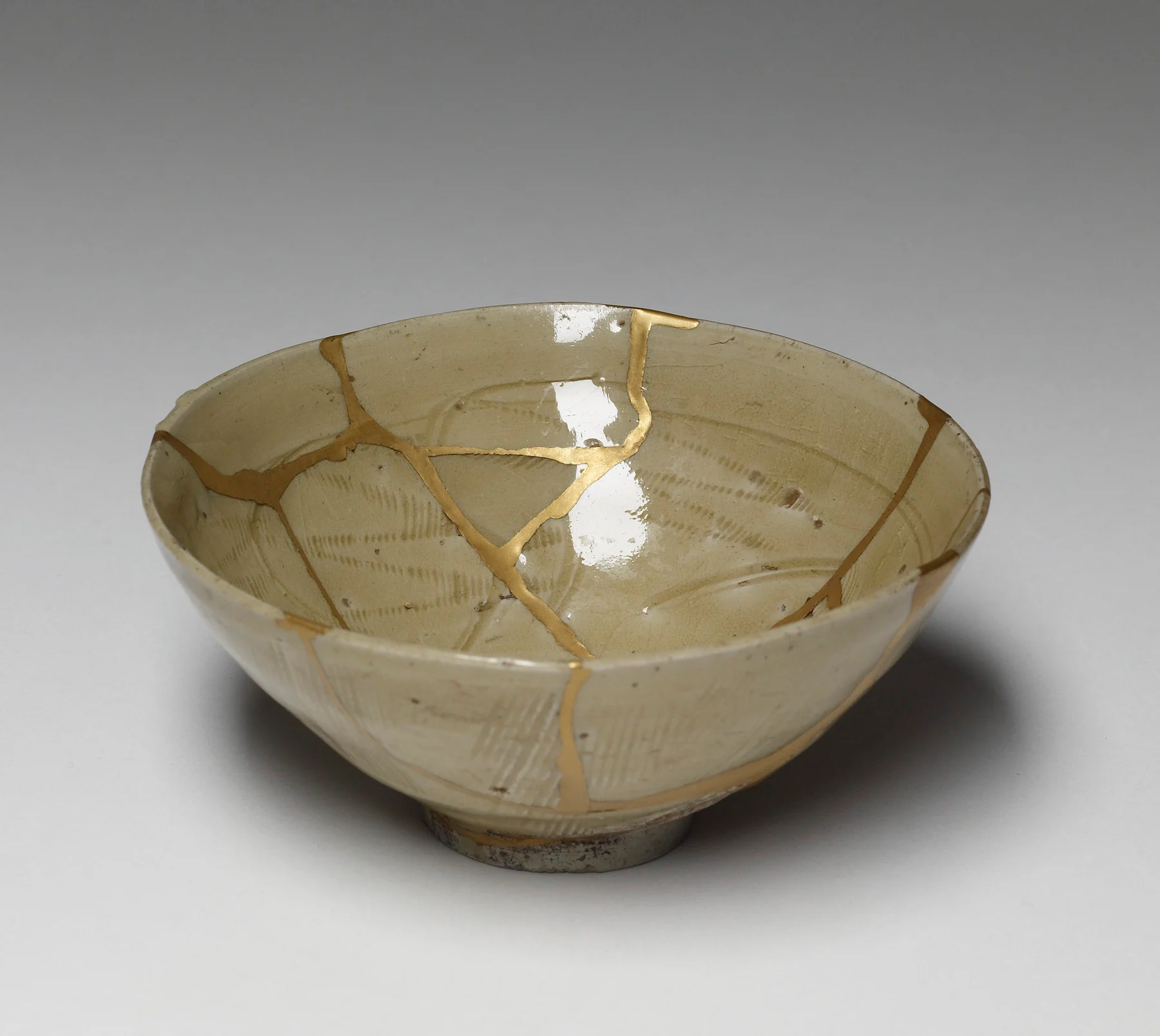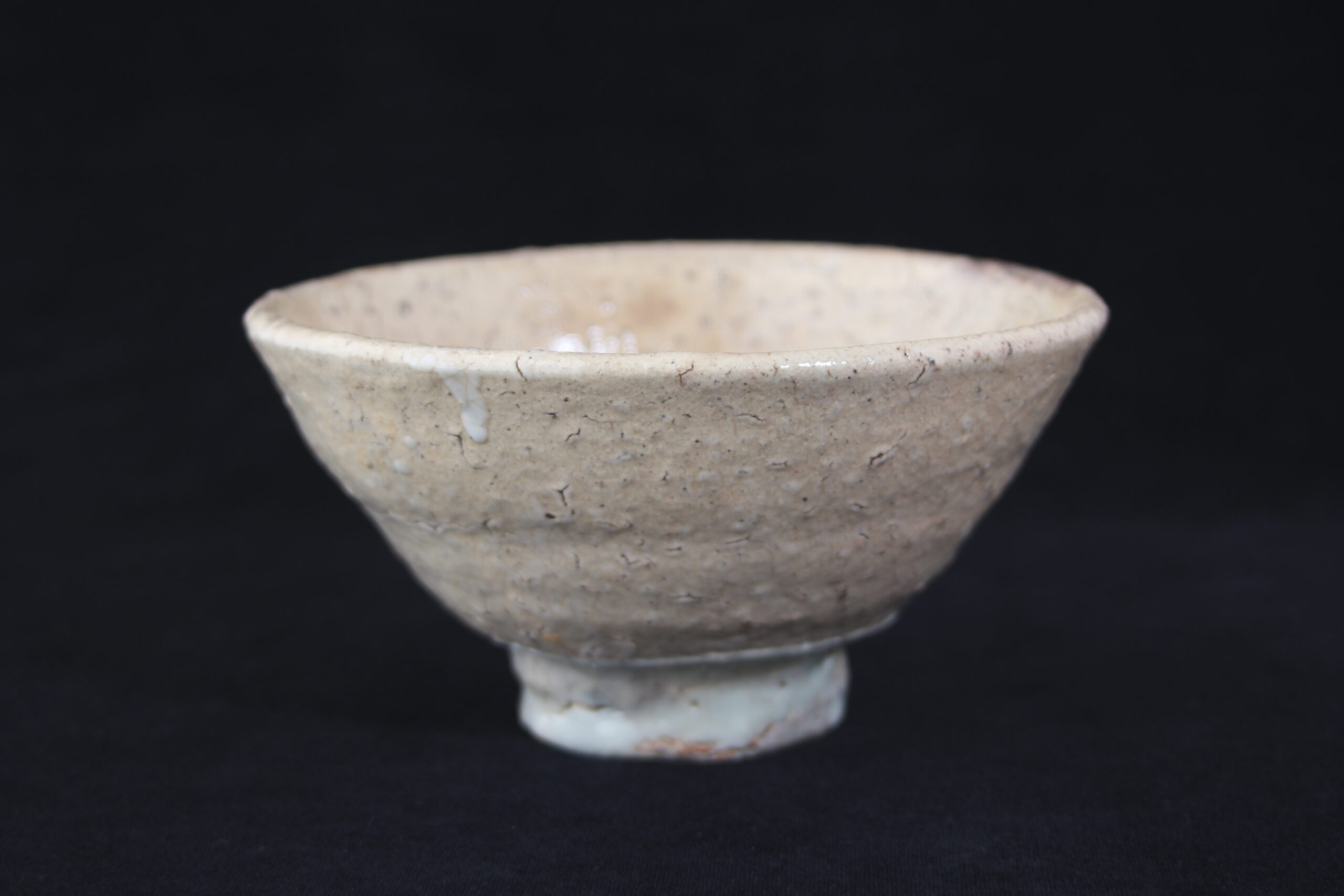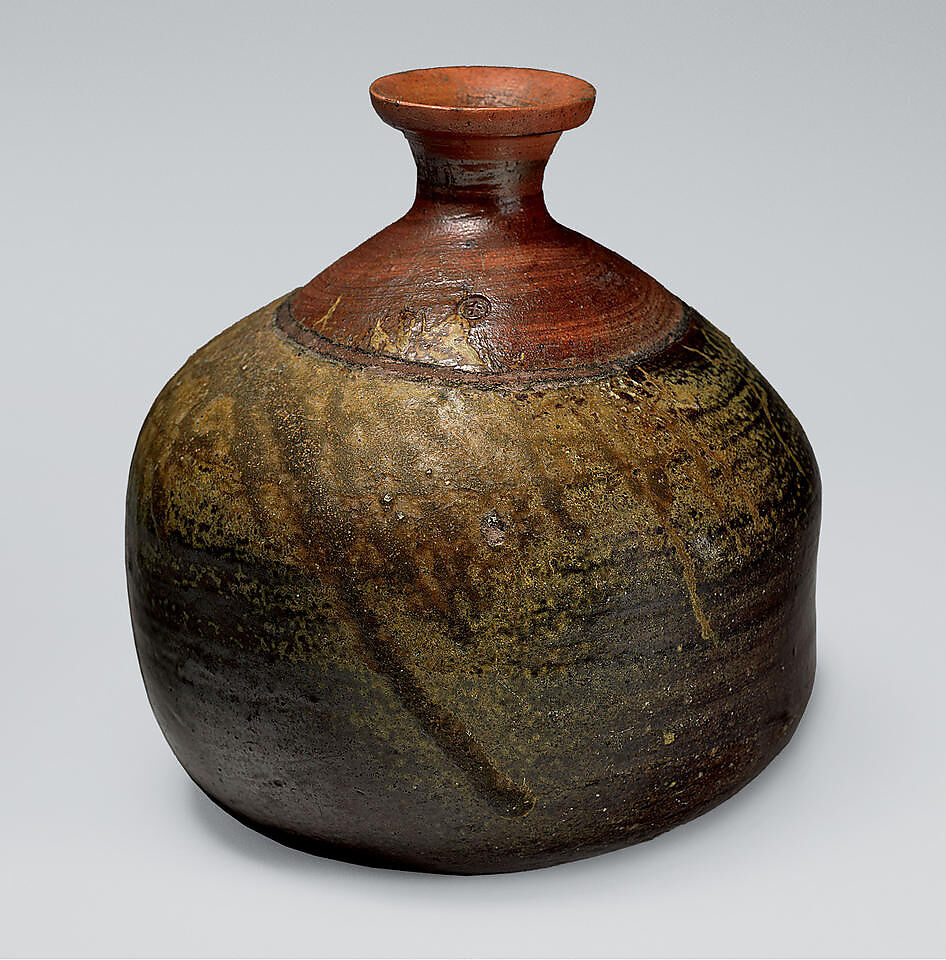
Pick up a Bizen guinomi and turn it in the light, and you’re looking at something unusual in ceramics: an object with no glaze at all, whose entire visual character was decided by clay, flame, ash, and roughly a week and a half spent inside a kiln. Nothing was painted on. Nothing was dipped or brushed. What you’re holding is closer to a photograph of a specific firing than a decorated object — and once you know how to read it, that photograph turns out to be unusually detailed.
This guide goes deeper into Bizen than the overview in our regional pottery guide: its full history, how the firing process actually works, the specific vocabulary collectors use for what the kiln leaves behind, and what separates a piece worth collecting from one that isn’t.
A History Longer Than the Name Suggests
Bizen ware’s roots reach back further than the ceramic tradition most people associate with the name. The area around present-day Bizen City, in Okayama Prefecture, was already producing sue-ki (須恵器) — grey stoneware fired in reduction kilns — from the Kofun period onward, part of a cluster of ancient kiln sites now known as the Oku kiln group. It wasn’t until the late Heian and early Kamakura periods, roughly the twelfth century, that production shifted specifically to the Inbe district and began developing into what we’d now recognize as Bizen ware.
The clay itself dictated an early technical fork. Kamakura-period Bizen fired in reduction produced grey stoneware; later in the same period, a shift to oxidation firing produced the reddish-brown tone that’s now considered the hallmark Bizen color. Ware from this early stretch is known as Ko-Bizen (“old Bizen”) and is prized today specifically for the qualities that made it commercially successful at the time: everyday storage jars and mortars valued for being, in period accounts, nearly indestructible.
Production scaled up considerably in the Muromachi period, when potters switched from mountain clay (yama-tsuchi) to rice-paddy clay (ta-tsuchi), adopted the wheel for faster production, and built large semi-underground kilns. Local production eventually consolidated under six kiln-owning families — Kimura, Mori, Tonguu, Terami, Ōe, and Kaneshige — who held something close to a production monopoly that lasted until the end of the Edo period. That last name is worth pausing on: the Kaneshige family that would produce twentieth-century Bizen’s most important figure had already been one of Bizen’s six ruling kiln families for centuries before he was born.
As tea ceremony culture spread through the Momoyama period, Bizen’s plain, unglazed character found a second market beyond everyday storage ware, prized by tea practitioners for exactly the qualities that made it unfashionable elsewhere. But by the late Edo period, competition from Karatsu and Seto had begun eroding Bizen’s market position, and the Meiji through early Shōwa periods were a genuine low point for the tradition — individual kilns survived in part by producing drainage pipes and firebrick rather than art ware.
The person generally credited with reversing that decline is Kaneshige Tōyō (1896–1967), who researched and revived Momoyama-era Bizen techniques that had fallen out of practice, and who in 1956 became the first ceramic artist ever designated a Living National Treasure. Fujiwara Kei and Yamamoto Tōshū, both later Living National Treasures in their own right, extended his work in the following decades. Bizen ware was formally designated a Traditional Craft by Japan’s Ministry of Economy, Trade and Industry in 1982, and in 2017 it was recognized, alongside the other Six Ancient Kilns, as part of a Japan Heritage designation.
What Actually Defines Bizen
Two things, inseparably: the clay, and the decision to leave it alone.
Bizen clay is fine-grained and unusually iron-rich, dug from rice-paddy deposits around the Inbe district. Fired without any applied glaze, that iron content is what produces the deep reddish-brown that most people picture when they hear “Bizen” — but that color is really just the default outcome, the state the clay settles into when nothing unusual happens to it during firing. Almost everything collectors actually look for in a piece is a deviation from that default, caused by exactly where the piece sat in the kiln and what touched it during the week-plus it spent there.
Inside the Kiln
Traditional Bizen firing uses one of three kiln types — the single-chamber anagama, the large communal ōgama historically used by the six ruling families, and the multi-chambered noborigama, the most common in use today. A single firing can hold roughly a thousand pieces of varying sizes, carefully arranged using rice straw and, in some workshops, aluminum powder to keep pieces from fusing to each other or the kiln furniture during the burn.
Firing itself runs at approximately 1,250°C for seven to ten days, after which the fire is allowed to die down and the kiln is left sealed for a further four to five days before anything is unloaded. Where a specific piece sits during that entire stretch — how close to the firebox, how deeply buried in ash, whether it’s wrapped in straw or stacked against another piece — determines almost everything about how it will look when the kiln finally opens. This is why kiln placement is such a central part of a Bizen potter’s actual skill: the visible decoration isn’t applied afterward, it’s planned for in advance, then handed over to several days of fire the potter can’t see or adjust once it’s underway.
Reading the Kiln Effects: A Fuller Glossary
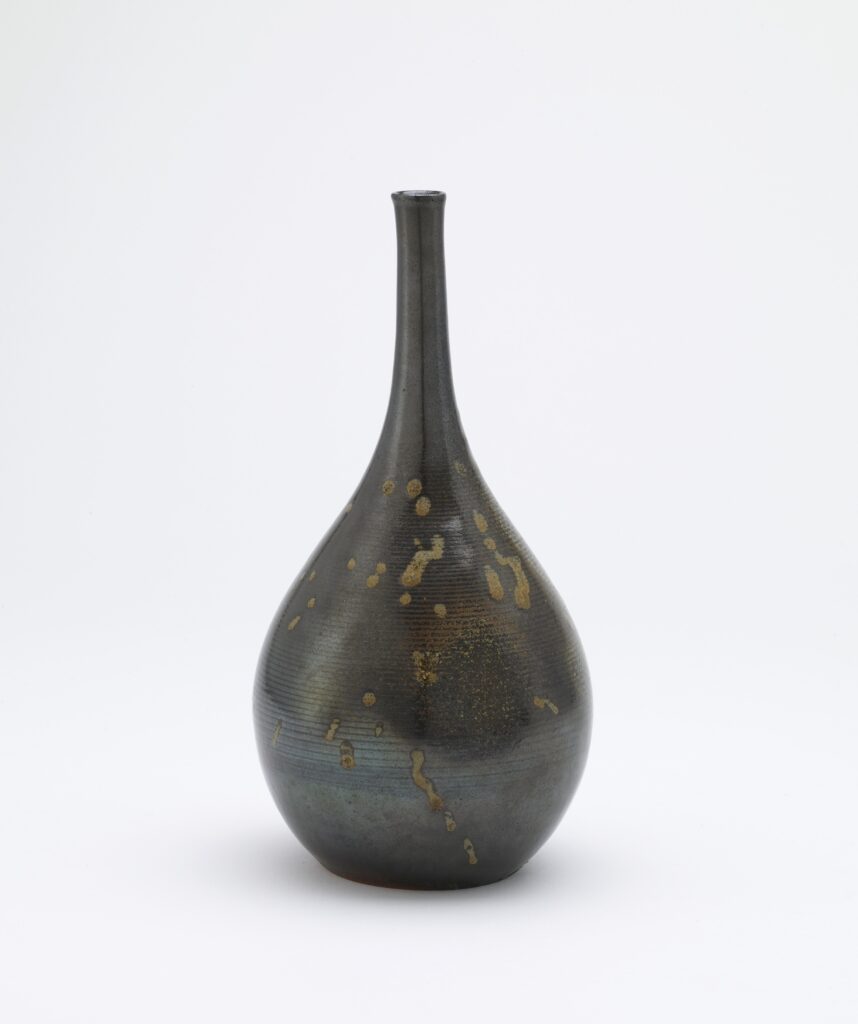
Our companion piece on glaze and firing introduced Bizen’s best-known effects — goma, hidasuki, and sangiri. Two further effects are specific enough to Bizen, and distinctive enough, to be worth knowing on their own.
Botamochi (牡丹餅), “rice cake.” Round, pale discoloration patches — white, red, or brown depending on exact conditions — left where a smaller piece (often a guinomi) was stacked directly on top of a larger one during firing, shielding that circular patch of surface from direct flame contact. The name comes from the pattern’s resemblance to a rice cake sitting on the surface. Originally a byproduct of practical space-saving stacking in kilns without shelving, the effect is now sometimes created deliberately, using a flat clay wafer placed for exactly this purpose.
Ao-Bizen (青備前), “blue Bizen.” Where most Bizen firing is oxidizing — plenty of oxygen reaching the piece, producing the standard reddish-brown — ao-Bizen results from the opposite: a piece fired in a low-oxygen (reduction) pocket within the kiln, where Bizen’s iron-rich clay turns blue-grey to black instead of red. Because these reduction pockets are limited and hard to predict inside a kiln built primarily for oxidation firing, ao-Bizen has always been comparatively rare and difficult to produce intentionally — historically associated with incense burners and other tea-culture objects precisely because of that scarcity. Two named sub-variants exist: shizen-ao (“natural blue”), arising from ember or ash burial, and shio-ao (“salt blue”), produced by throwing salt into the kiln during firing.
Once these five effects — goma, hidasuki, sangiri, botamochi, and ao-Bizen — are part of a collector’s working vocabulary, a Bizen piece stops reading as simply “brown and rustic” and starts reading as a specific, reconstructable account of where it sat and what happened around it during one particular firing.
Notable Makers
Kaneshige Tōyō, Fujiwara Kei, and Yamamoto Tōshū remain the three names most central to twentieth-century Bizen, each a Living National Treasure and each associated with reviving or extending specific Momoyama-era techniques rather than inventing an entirely new style. Beyond these three, Bizen has a genuinely large community of active workshops and individual potters working today, many tracing their training back through one of these lineages or through the historical six-family kiln system described above — a detail worth confirming against a specific piece’s documentation rather than assuming, since attribution below the level of a Living National Treasure requires the same evidence standards as any other maker claim.
Typical Forms
Bizen’s unglazed surface and reputation for improving with use have made it especially associated with drinking vessels: guinomi (sake cups) and tokkuri (sake flasks) are probably the most commonly encountered forms, prized in part because unglazed stoneware is porous enough to be said, by some drinkers, to actually soften the character of sake poured into it over time. Chawan and hanaire (flower vases) are also well represented, along with functional tableware for daily use — a reminder that Bizen’s original market was practical storage ware, not art objects, even though its modern reputation rests heavily on the latter.
A Collector’s Guide to Bizen
A few practical points worth keeping in mind when evaluating a piece:
Clay color and texture are a rough regional fingerprint. Bizen’s fine, iron-rich clay body should read differently under close inspection than the coarser, feldspar-flecked clay of neighboring Six Ancient Kiln traditions like Shigaraki. If a piece is attributed to Bizen but the clay body looks visibly wrong for it, that’s worth investigating further before accepting the attribution.
A star-shaped mark can indicate a maker’s stamp, but check where it sits. Because Bizen’s large communal kilns historically fired many workshops’ pieces together, individual potters incised a star-shaped mark into the shoulder or underside of a piece specifically so their work could be identified after firing — a practice documented on Momoyama-period Bizen ware and still relevant to how older pieces are attributed today. A star mark alone isn’t proof of a specific named maker; it confirms the piece as genuine Bizen production practice, but tracing it to an individual workshop still requires the same evidence standard as any other attribution.
Kiln effects should look like they arose from the process, not from decoration applied afterward. Goma should sit where ash would plausibly have landed and melted; hidasuki should follow a plausible straw-wrap pattern rather than looking painted on. This is the same principle discussed in our wabi-sabi guide — the value is specifically in the effect being a genuine record of the firing, not a simulation of one.
Rarity claims deserve the same evidence standard as any attribution. Ao-Bizen’s genuine rarity is well documented, but that documented rarity is also exactly why it’s worth being cautious about any seller who reaches for the term casually — a claim of ao-Bizen, or of a piece coming from a particularly difficult kiln position, should be something you can actually see in the piece, not just something you’re told.
Tomobako and maker attribution follow the same rules as everywhere else. A signed box or a documented lineage back to a known workshop changes a piece’s value and historical standing considerably; an unsigned, undocumented piece can still be a genuine, well-made example of Bizen ware, but it should be described and priced as what it actually is rather than what a more specific attribution would make it.
Why Bizen Rewards Close Attention
More than most Japanese ceramic traditions, Bizen asks you to accept that its maker didn’t fully control the outcome — and to find that lack of control interesting rather than concerning. A goma fleck, a run of hidasuki, a patch of botamochi: none of it was painted on to make the piece look a certain way. It’s a direct record of a specific object’s specific week inside a specific fire, which is exactly why no two pieces, even from the same firing, ever come out quite the same.
About HOJO Japanese Ceramic
HOJO Japanese Ceramics is based in Tobe Town, Ehime Prefecture, one of Japan’s historic pottery regions.
We research, curate, and share authentic Japanese ceramics with collectors around the world.
Explore our curated collection in the HOJO Etsy Shop.