In the fifteenth century, a Chinese celadon tea bowl belonging to the shogun Ashikaga Yoshimasa developed a crack across its base. Yoshimasa sent it back to China, hoping for a replacement of equal quality. None existed. The bowl came back instead repaired with iron staples driven across the crack from the outside — a working fix, not a beautiful one. The staple marks were later said to resemble a swarm of locusts, and the bowl came to be known as Bakōhan, “locust-clasp bond.” It survives today, staples and all, as an Important Cultural Property in the Tokyo National Museum.
Bakōhan isn’t kintsugi. There’s no lacquer in it, no gold. But the story is usually told as kintsugi’s philosophical ancestor, because of what it represents: a broken object, repaired visibly rather than hidden or discarded, its damage becoming part of what makes it worth keeping. What Yoshimasa’s court did next — and what actually became kintsugi — took that same impulse and gave it a name, a technique, and eventually a whole material philosophy.
Where Kintsugi Actually Comes From
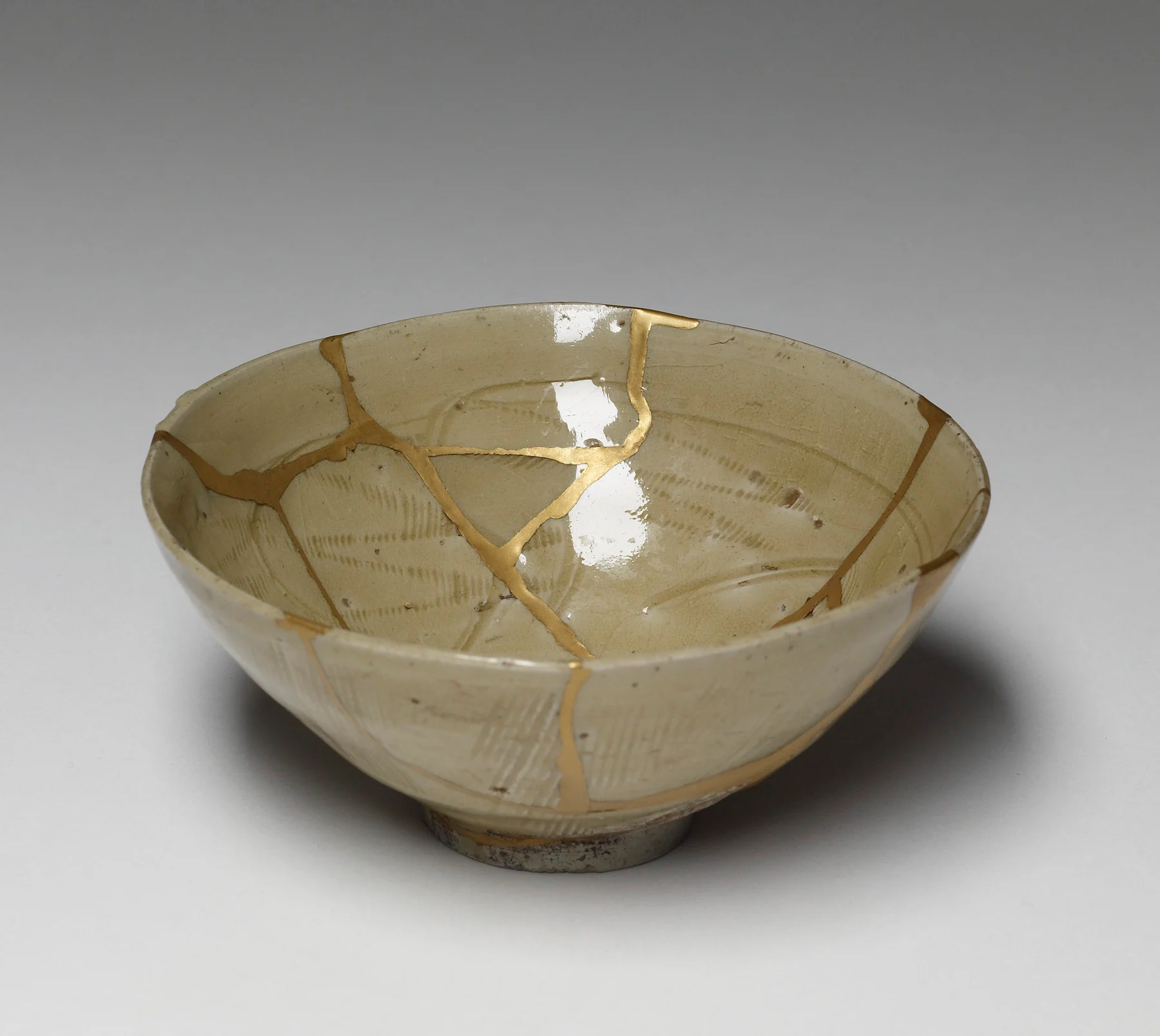
Kintsugi (金継ぎ, “gold joinery”) is generally understood to have emerged during the Muromachi period, in the same courtly world that produced Bakōhan’s story. Yoshimasa himself, after retiring to the Silver Pavilion in eastern Kyoto, became a major patron of tea ceremony, ikebana, and ink painting, all deeply shaped by Zen aesthetics. As tea culture flourished, tea utensils — bowls especially — became genuinely precious objects, sometimes more valuable than the estates of the samurai who owned them. When one of these prized bowls cracked or broke, the response that developed wasn’t to discard it, but to rejoin it with urushi lacquer and finish the repair with dusted gold.
It’s worth being precise about what’s actually old here and what’s newer. Urushi itself — lacquer tapped from the sap of the Toxicodendron vernicifluum tree — has been used in Japan for repair and construction for close to nine thousand years; lacquer-mended tools have turned up in excavations from the Jōmon period, long before anyone was decorating a repair with gold. What’s specifically Muromachi-era is the aesthetic decision to make a lacquer repair visible and beautiful with gold, rather than simply functional. Kintsugi didn’t invent lacquer repair. It gave lacquer repair a reason to be seen rather than hidden.
What the Process Actually Involves
Traditional kintsugi is slow in a way that’s easy to underestimate from photographs, which only ever show the finished gold line. A full repair typically moves through several distinct lacquer preparations, each with its own name and purpose:
Mugi-urushi (raw lacquer mixed with wheat flour) is used first, to actually rejoin broken shards. Sabi-urushi (lacquer mixed with fine clay powder, tonoko) follows, filling any gaps, chips, or missing material left by the break. Roiro-urushi provides the final smooth, lustrous finishing layer. Only at the very end does e-urushi, a thin adhesive lacquer layer, get applied and dusted with gold powder while still tacky, then burnished once cured — traditionally with something as simple as a boar’s tooth or a piece of agate.
Every layer needs real curing time, usually in a humid enclosed box called an urushi-buro, since lacquer hardens through a humidity-dependent chemical reaction rather than simply drying. A single repair can reasonably take anywhere from several days to several weeks. This is also why urushi isn’t something to handle carelessly: it contains urushiol, the same compound that makes poison ivy irritating to skin, and reactions to raw lacquer are a real, well-documented occupational hazard for people who work with it regularly.
More Than One Way to Repair
“Kintsugi” covers a small family of related techniques, not a single fixed method, depending on what actually happened to the piece:
Hibi (“crack”) is the simplest case: a fine crack, no missing material, filled and finished with a thin gold line. Kake no kintsugi (“chip repair”) handles larger breaks or missing chunks, rebuilding the lost volume with lacquer putty before gilding. Yobitsugi (“call-and-join”) is the most visually striking variant: when a piece is missing material entirely, a fragment from an entirely different, unrelated ceramic piece is used to fill the gap instead of lacquer alone — deliberately mixing two objects’ histories into one. Gold isn’t even mandatory; silver (gintsugi) and, less commonly, platinum finishes exist for a different tonal effect.
Genuine Kintsugi Versus What Gets Sold as Kintsugi
Here’s where accuracy matters most for anyone actually buying or collecting. In the last decade or so, kintsugi’s visual language — a gold seam running through broken ceramic — has become popular enough internationally that a large market of home repair kits now sells the look using two-part epoxy resin mixed with gold-colored mica or synthetic metallic powder, rather than urushi and real gold. These kits are genuinely useful for a quick, food-safe-adjacent home repair on an everyday mug, and there’s nothing dishonest about them as long as they’re sold as what they are.
The trouble is when they’re sold, or understood, as the same thing as traditional kintsugi. They aren’t. The term hon-kintsugi (“true” or “authentic” kintsugi) has only entered common use recently, specifically because it became necessary to distinguish the original urushi-and-gold practice from the resin version — a linguistic tell in itself, since nobody needed to specify “authentic” anything before an inauthentic version existed to compare it to. Epoxy resin doesn’t have urushi’s depth, doesn’t age the same way, and carries none of the same material lineage running back through nine thousand years of Japanese lacquer craft. For a collector, a piece repaired with real urushi and gold or silver leaf is a meaningfully different object — historically, materially, and often in actual monetary value — than one touched up with a craft-store resin kit, even if the two can look similar in a photograph.
Why the Repair Is the Point, Not the Flaw
Kintsugi is often introduced as an illustration of wabi-sabi, and the connection is real: an object’s transience and imperfection, treated as something worth seeing rather than concealing, is exactly the wabi-sabi instinct discussed elsewhere on this site. Kintsugi pushes that idea one step further than a naturally occurring kannyū crackle or an ash-fired kiln mark does, because breakage is not something that happened to the piece during its making — it’s something that happened afterward, in its life, often by accident, sometimes through decades of use. Repairing it with gold rather than disguising it treats that later event as part of the object’s real history, not a regrettable interruption of it.
There’s a related Japanese idea worth knowing alongside kintsugi: mottainai (もったいない), a sense of regret at wasting something still valuable. Kintsugi is, among other things, mottainai given physical form — the position that a broken bowl hasn’t stopped being worth keeping, it’s simply entered a new chapter of its own history, one that now includes the break itself.
What to Look For as a Collector
If you’re evaluating a piece with a kintsugi repair, a few practical questions are worth asking before assuming it’s the traditional kind. Does the gold line have real depth and slight texture under raking light, or does it look uniformly flat and glossy in a way epoxy typically does? Is there any documentation or seller explanation of the repair method and materials used? Does the color of the repair line look like true gold leaf or powder — warm, slightly variable in tone — rather than a uniform, slightly too-bright metallic gold associated with synthetic mica pigments? None of these questions require special equipment, just attention, and asking them directly of a seller is entirely reasonable — a seller who has actually researched their piece should be able to answer.
None of this is meant to suggest a resin repair is worthless or dishonest on its own terms. It’s meant to suggest that “kintsugi” is a specific claim, with a specific material history behind it, and that claim deserves the same care in verification as an attribution to a named kiln or a documented artist — which is exactly the standard this site tries to apply everywhere else.
About HOJO Japanese Ceramics
HOJO Japanese Ceramics is based in Tobe Town, Ehime Prefecture, one of Japan’s historic pottery regions.
We research, curate, and share authentic Japanese ceramics with collectors around the world.
Explore our curated collection in the HOJO Etsy Shop.