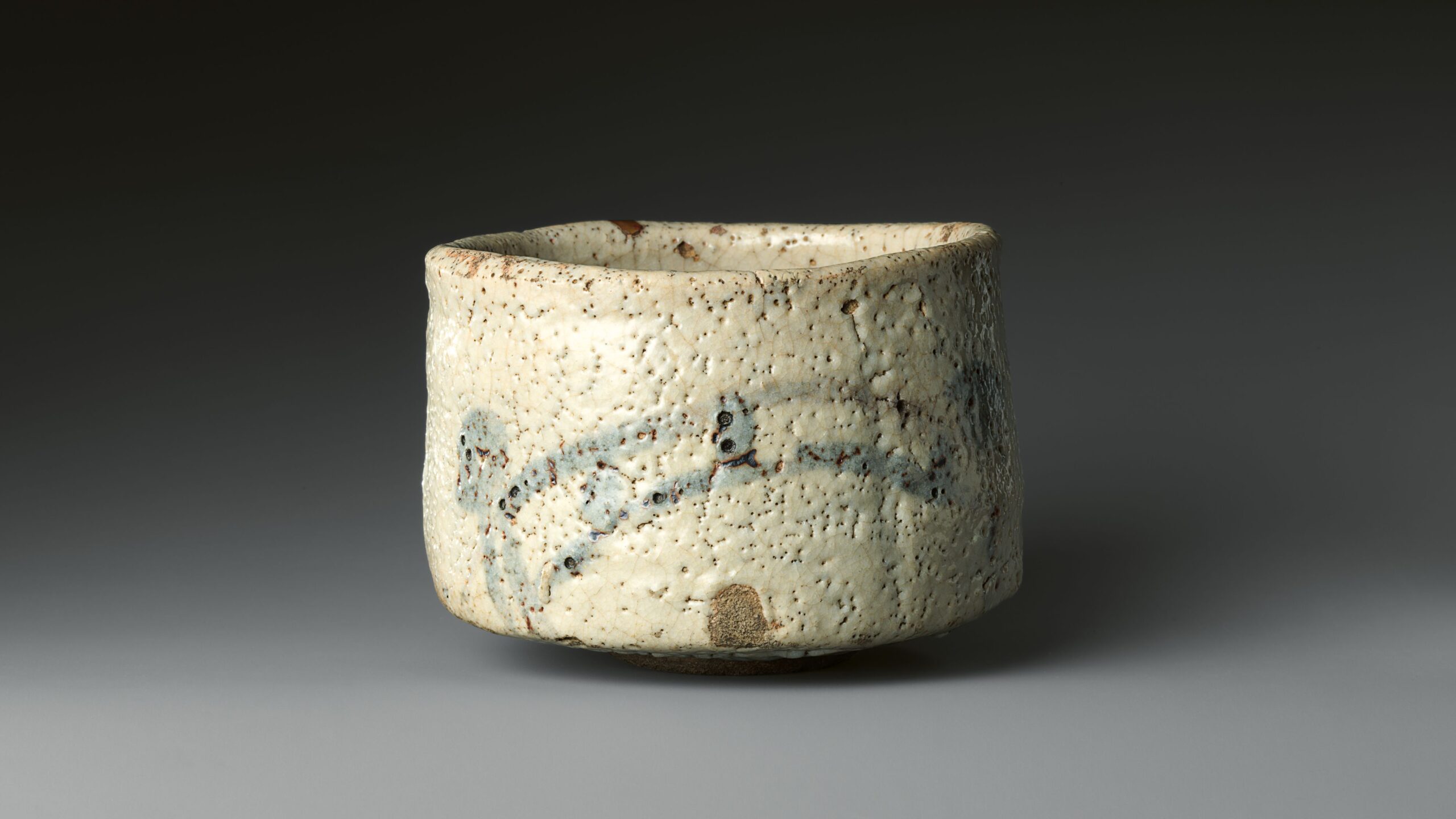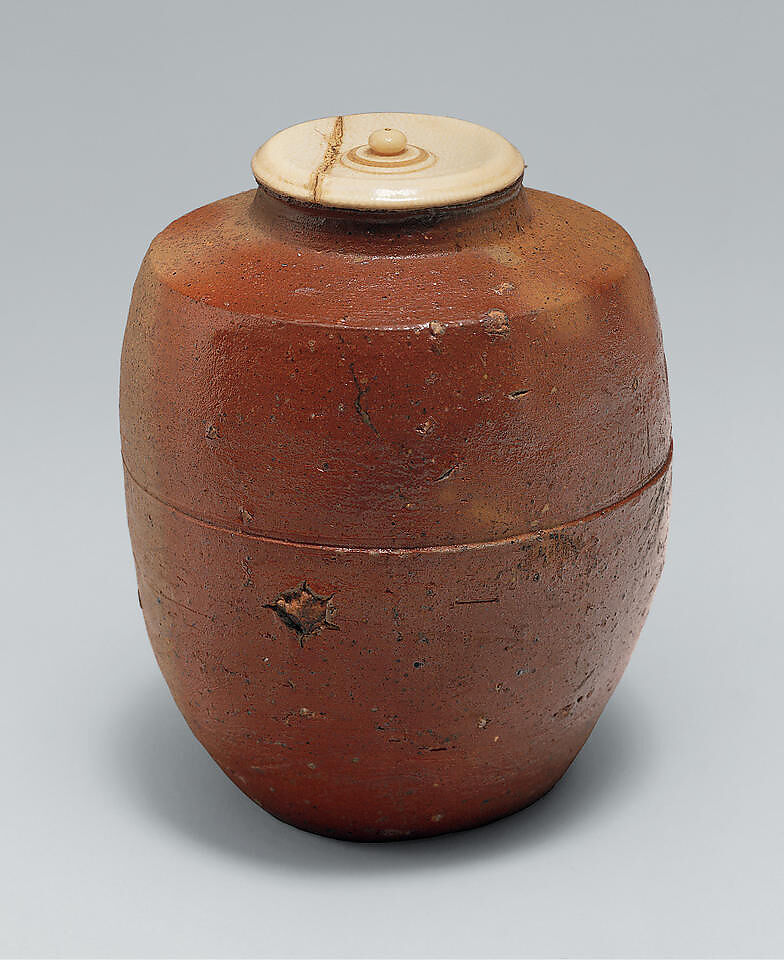
Pick up two chawan side by side — one cylindrical and narrow, one wide and shallow — and before you’ve read a single maker’s name, they’re already telling you something. One was made to keep tea warm through a winter afternoon. The other was made to let tea cool quickly on a humid summer day. Shape in Japanese ceramics is rarely arbitrary. It’s function, season, and regional inheritance, compressed into a silhouette you can learn to read at a glance.
This guide covers the vocabulary that lets you do exactly that: the major chawan shapes, the parts of the bowl each shape is built from, and the terminology collectors use to describe what they’re looking at. None of this is decoration for its own sake — a kiln’s identity, a bowl’s age, and even its likely region of origin are often legible in these details before you’ve done any research at all.
Reading a Bowl by Its Silhouette
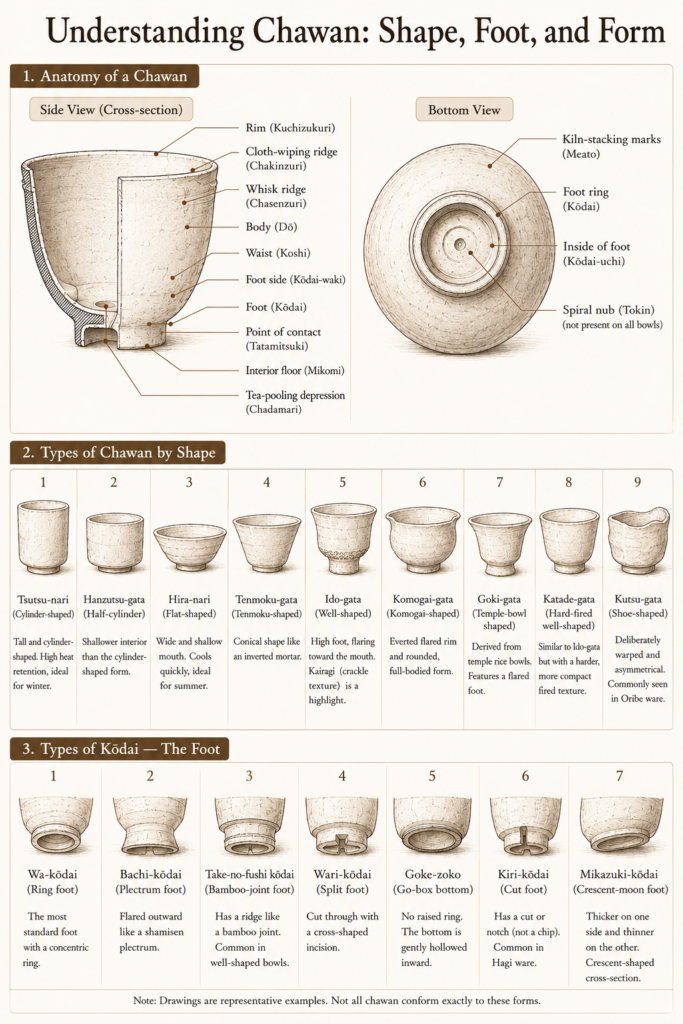
Japanese tea bowl shapes are traditionally sorted a few different ways — by season, by school of tea, by country of origin — but the most useful starting point for a new collector is simply the profile: what happens between the rim and the foot.
Tsutsu-nari (筒形), the cylindrical form. A tall, narrow bowl with a deep interior, built to retain heat. Tea poured into a tsutsu-gata bowl stays warm considerably longer than in a shallow one, which is why this shape is associated with winter use — it’s often specifically called a fuyu-jawan (“winter bowl”) in tea practice. A shorter variant with a shallower interior is called hanzutsu-gata (半筒形, “half-cylinder”), common among Ki-Seto, Seto-guro, Raku, and Shino bowls.
Hira-nari (平形), the flat form. The functional opposite of tsutsu-nari: a wide, shallow bowl with an open mouth that lets tea cool quickly, making it the traditional summer shape (natsu-jawan). The wide mouth also makes whisking more difficult to master than it looks — a detail worth knowing if you intend to actually use a piece rather than only display it.
Tenmoku-gata (天目形), the conical form. Named after Tenmoku ware, the iron-glazed bowls imported from Song-dynasty China that dominated early Japanese tea culture, this shape flares outward from a small foot in a clean, cone-like line, tapering back inward slightly at the rim. It’s one of the older shape categories in this list, predating the wabi-cha aesthetic that shaped many of the other forms here.
Ido-gata (井戸形), the Korean well-bowl form. Derived from Ido chawan — utilitarian Korean rice bowls that Japanese tea masters adopted and elevated to the top rank of tea ceramics — this shape has a relatively tall foot and walls that flare outward toward the rim in a shape closer to a mortar than a cup. Ido-gata bowls are traditionally expected to show kairagi (梅花皮), a crawling, frost-like glaze texture that gathers near the foot where the glaze runs thin — considered a mark of quality rather than a flaw.
Komogai-gata (熊川形), the Komogai form. Another Korean-derived shape, named for the port from which these bowls were historically shipped rather than where they were made. It’s defined by a flared, everted rim and a rounded, fuller body than Ido-gata, giving it a softer overall profile.
Goki-gata (呉器形), the Goki form. Named for its resemblance to lacquered rice bowls used in Buddhist temples (goki, monks’ rice bowls), this shape is typically large and relatively thin-walled, with a distinctively broad, flaring foot. Several named sub-variants exist — momiji-goki (“maple-leaf Goki,” for its reddish surface tone) and daitoku-ji-goki among them — which is a useful reminder that shape names in this tradition often layer a specific historical nickname on top of a broader category.
Katade-gata (堅手形), the “hard hand” form. A harder-fired, more tightly vitrified relative of Ido-gata, with a similar flared profile but a cooler, more restrained surface — less glaze crawl, a smoother feel. A softer, paler variant is sometimes called tamago-de (“egg-hand”).
Kutsu-gata (沓形), the shoe form. A deliberately irregular, non-circular shape — pressed or paddled out of round rather than thrown symmetrically — most associated with Oribe ware and the taste of the tea master Furuta Oribe, who favored asymmetry as a way of keeping a bowl visually alive rather than static.
This list covers the shapes you’ll encounter most often, but it isn’t exhaustive — regional kilns and individual schools of tea have named further sub-variants over the centuries. Where a shape is unusual enough to need its own explanation, we’ve included reference images below rather than adding every minor variant to the text.
The Parts of a Bowl
Once the overall silhouette is familiar, the next layer of vocabulary describes specific parts of the bowl — the details a collector checks almost automatically when handling a piece.
Kuchizukuri (口作り), the rim. How the mouth of the bowl is finished matters both functionally (how it meets the lips) and visually. A rim that flares outward is called habazori (端反り); one that curves gently inward is uchizori (内反り); a rim with no curve at all, running straight up from the body, is sugu-guchi (直口). Irregular, wave-like rims — common in Oribe and some Shino bowls — are generally just described as hen’kei (変形, “irregular”) rather than given a single fixed term.
Dō (胴), the body. The main volume of the bowl between rim and foot. This is where throwing marks (rokuro-me, 轆轤目), finger impressions, and any hand-applied texture are most visible, and where glaze pooling and ash effects typically show their strongest character.
Mikomi (見込み), the interior floor. The bottom of the bowl’s interior, visible when looking down into it — the part a tea drinker sees last as the bowl is emptied. In many appreciation traditions, the mikomi is examined specifically for glaze pooling, kiln marks, or a maker’s brushed signature.
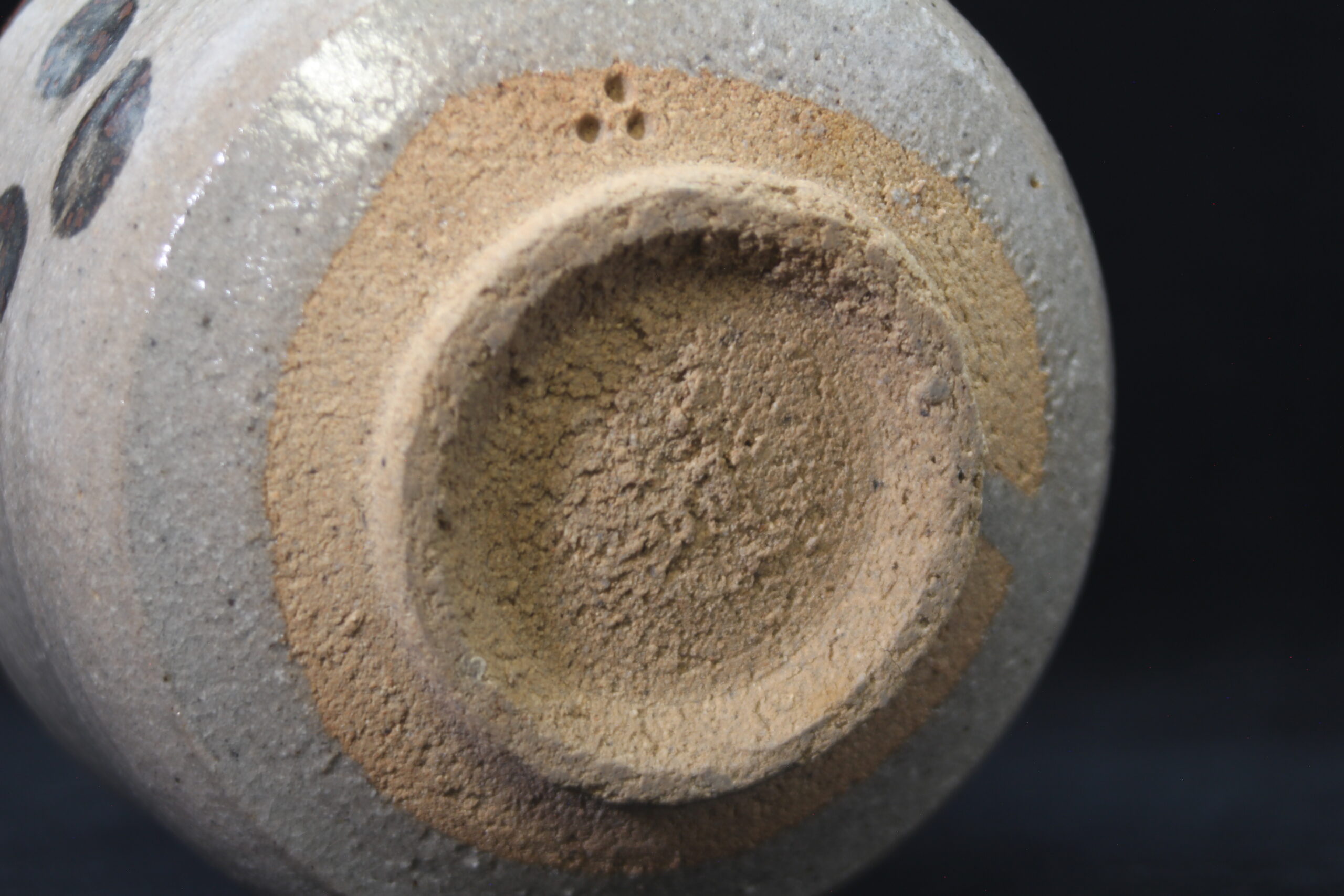
Kōdai (高台), the foot. The ring or base that lifts the bowl slightly off the surface it rests on. Functionally, the kōdai keeps a hot bowl from transferring heat directly to a table or hand; aesthetically, it’s one of the most closely examined parts of any chawan, partly because it’s usually left unglazed, exposing the raw clay body directly — often the single clearest piece of evidence for identifying where and from what clay a piece was made.
Reading the Foot: Kōdai Types
Because the foot is examined so closely, its shape has its own detailed vocabulary. A few of the most commonly encountered types:
Wa-kōdai (輪高台), the ring foot. The standard, most common form: a simple, evenly carved circular ring. The baseline against which every other type below is a deliberate variation.
Bachi-kōdai (撥高台), the plectrum foot. Named for its resemblance to the bachi pick used to play the shamisen, this foot flares outward from a narrower base to a wider point of contact with the surface, giving the bowl a stable, grounded stance. Common on Goki-type bowls and larger, function-first pieces.
Take-no-fushi kōdai (竹の節高台), the bamboo-joint foot. Carved with a ridge partway up its height, resembling the joint of a bamboo stalk. Frequently seen on Ido chawan, where it’s considered a mark of a well-made, classically proportioned foot.
Wari-kōdai (割高台), the split foot. A foot cut through with one or more deliberate incisions — often in a cross pattern — so that it’s no longer a single unbroken ring. Associated particularly with Karatsu and some Mino wares, this is a clear example of a maker treating a purely structural element as a place for visible, intentional decision-making.
Goke-zoko (碁笥底), the go-box bottom. Rather than a raised ring, the base is gently hollowed inward without a distinct raised foot at all — named for its resemblance to the base of a goke, the lidded box used to hold Go stones. Common on Ki-Seto, Shino, and some Raku bowls.
Kiri-kōdai (切り高台), the cut foot. A foot with a small notch or wedge cut out of one section, breaking the otherwise continuous ring. This is especially characteristic of Hagi ware, where — because the ware is otherwise so lightly decorated — the treatment of the foot often carries more individual expression than any other part of the bowl.
Mikazuki-kōdai (三日月高台), the crescent-moon foot. A foot that is noticeably thicker on one side than the other, in cross-section resembling a crescent moon. Sometimes the result of a deliberate stylistic choice, sometimes simply the visible trace of a piece having shifted slightly during trimming — either way, it’s treated as a legitimate part of a bowl’s character rather than a flaw to be hidden.
Tokin (兜巾), the spiral nub. Not a foot shape itself, but a specific feature sometimes found inside the foot: a small raised, spiral-shaped nub left by the trimming tool, resembling the pointed cap (tokin) worn by yamabushi mountain ascetics. Its presence is one of several details tea practitioners traditionally check for on Ido chawan specifically.
As with shape names, this is a representative set rather than a complete catalogue — tomoe-kōdai (swirl-carved interiors), kugibori-kōdai (nail-scratch line patterns, seen on Iraho ware), and several further named variants exist.
Two More Terms Worth Knowing
Meato (目跡), kiln-stacking marks. Small unglazed spots — usually three or five, arranged in a ring — left where clay wads or supports kept pieces from fusing to each other or their kiln shelf during firing. Once a purely practical necessity, meato are now often read as evidence of traditional stacked firing, and are neither hidden nor apologized for on a well-regarded piece.
Tatamitsuki (畳付き), the point of contact. The specific narrow band of the foot that actually touches the surface a bowl rests on — named because that surface was traditionally a tatami mat. This is usually left completely unglazed, and it’s often the single most informative few millimeters on the entire object: color, grain, and iron content of the clay are usually clearest exactly here.
Why This Vocabulary Matters for Collecting
None of this is trivia for its own sake. A kōdai style strongly associated with one region, paired with a clay body that doesn’t match that region, is often the first sign that a piece’s attribution needs a second look. A shape name can narrow down likely production period before any signature or box inscription is even considered. And simply having the vocabulary changes what you notice: once “kōdai” and “kairagi” and “tokin” are part of your working vocabulary, a chawan stops being one object and starts being a small, legible record of the hands, the region, and the tradition that produced it.
The next guide in this series moves earlier in that process — from the finished bowl back to the clay it was made from, and the shaping techniques that turned raw material into form.
Read our guide to Japanese Ceramic Clay and Shaping Techniques →
About HOJO Japanese Ceramics
HOJO Japanese Ceramics is based in Tobe Town, Ehime Prefecture, one of Japan’s historic pottery regions.
We research, curate, and share authentic Japanese ceramics with collectors around the world.
Explore our curated collection in the HOJO Etsy Shop.