Most ceramic traditions in this guide have a founding story and then a long, continuous history afterward. Kutani has a founding story, roughly fifty years of production, a complete disappearance for the better part of a century, and then a deliberate, self-conscious revival by people who were, in a real sense, trying to reconstruct something they admired but didn’t fully understand. Few Japanese ceramic traditions carry this much unresolved mystery at the center of their own history — and it’s part of exactly what makes Kutani worth knowing well.
A Kiln That Appeared, Flourished, and Vanished
Kutani ware begins in the Meireki era, around 1655–57, when Maeda Toshiharu, first lord of the Daishōji domain — a branch of the larger Kaga domain, in what’s now Ishikawa Prefecture — learned that porcelain stone had been discovered in Kutani village, deep in the mountains near Yamanaka Onsen. He ordered a domain metalworker, Gotō Saijirō, to establish a kiln and produce color-glazed porcelain. According to some accounts, Gotō had traveled to Arita specifically to study porcelain technique before returning to establish the Kutani kiln — meaning Kutani’s origin is directly connected to the same technical foundation that produced Arita ware, transplanted to a mountain village roughly two hundred kilometers away.
For about fifty years, that kiln produced what’s now known as Ko-Kutani (“old Kutani”) — bold, confidently painted porcelain, ranked by later scholars alongside Kakiemon, Nabeshima, and Kyoto’s Ninsei ware as among the finest polychrome porcelain Japan produced in the seventeenth century. And then, sometime around 1700–1710, production simply stopped. The reason remains genuinely unresolved. It isn’t that historians have settled on an explanation collectors just haven’t heard — the honest answer, repeated across serious sources on the subject, is that nobody actually knows why one of early Edo Japan’s most accomplished kilns went silent after roughly half a century of work.
There’s a second, arguably even more fundamental controversy worth knowing about before going any further: where Ko-Kutani was actually made. The traditional account — a dedicated kiln at Kutani village, staffed by Gotō Saijirō under Maeda Toshiharu’s patronage — has been directly challenged by more recent archaeological and scientific study. Excavation and material analysis increasingly suggest that at least a substantial portion of what’s called “Ko-Kutani” porcelain was, in fact, produced at Hizen kilns in the Arita region, not at Kutani village at all — with the “Kutani” name only attached in the nineteenth century, once Kutani-village revival kilns began producing work that resembled it. Scholars disagree specifically on how much of the surviving Ko-Kutani corpus this applies to, and no consensus position has fully displaced the traditional Kutani-village account. This isn’t a minor academic footnote: it means “Ko-Kutani” may be, at least partly, a name describing a style rather than a confirmed place of manufacture — worth treating with real caution rather than repeating the traditional origin story as settled fact.
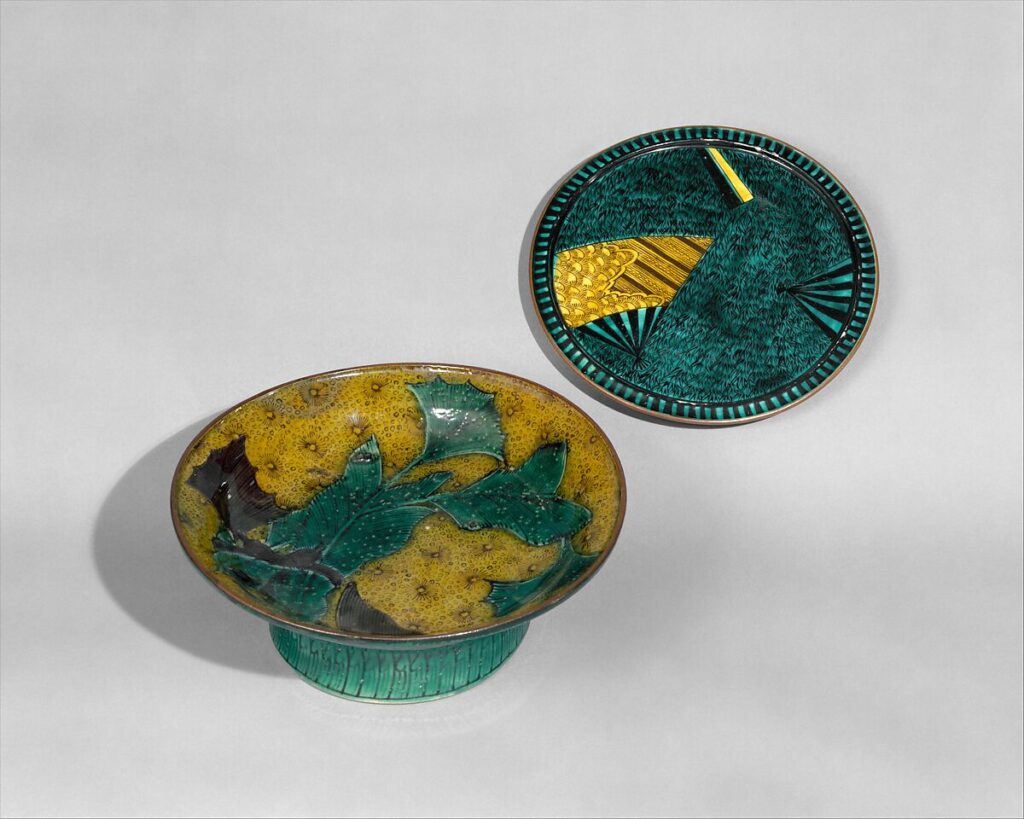
What Ko-Kutani Actually Looked Like
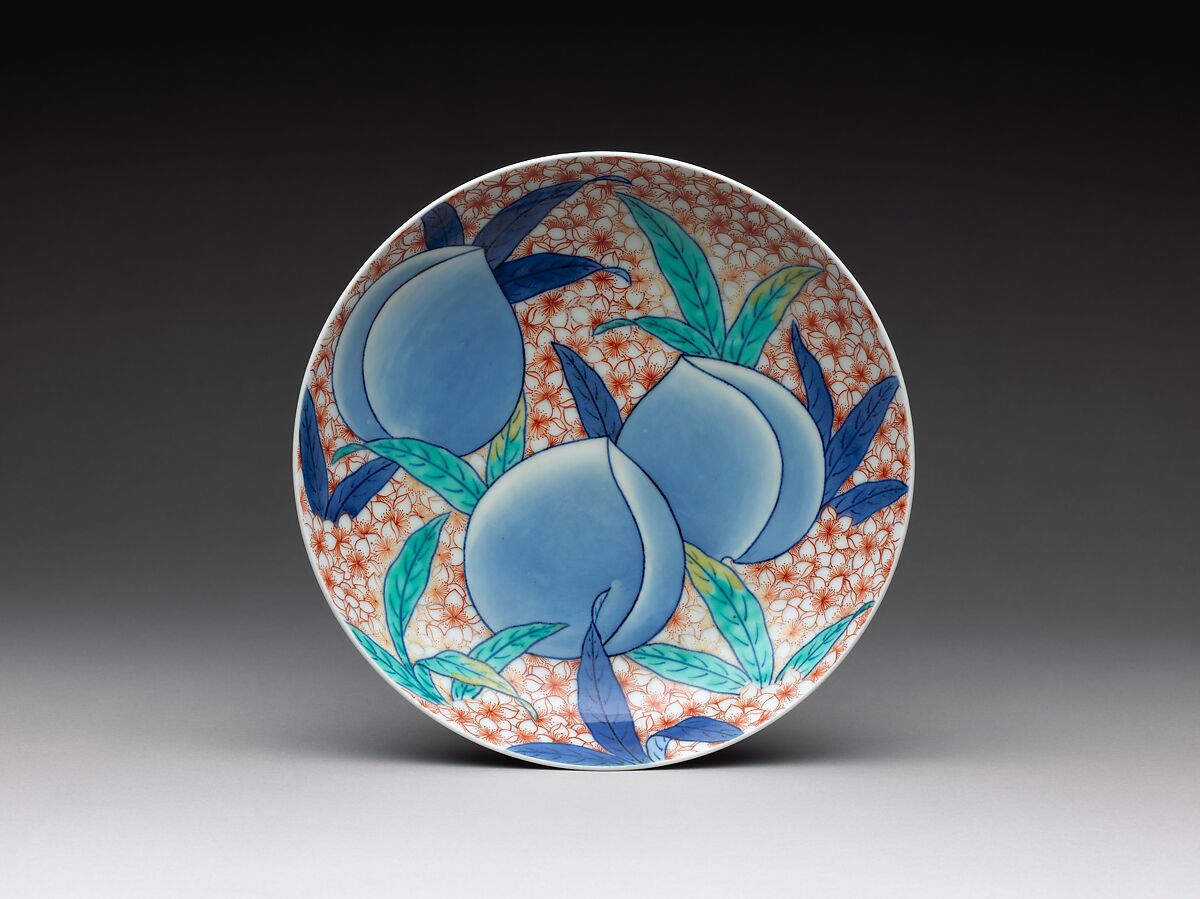
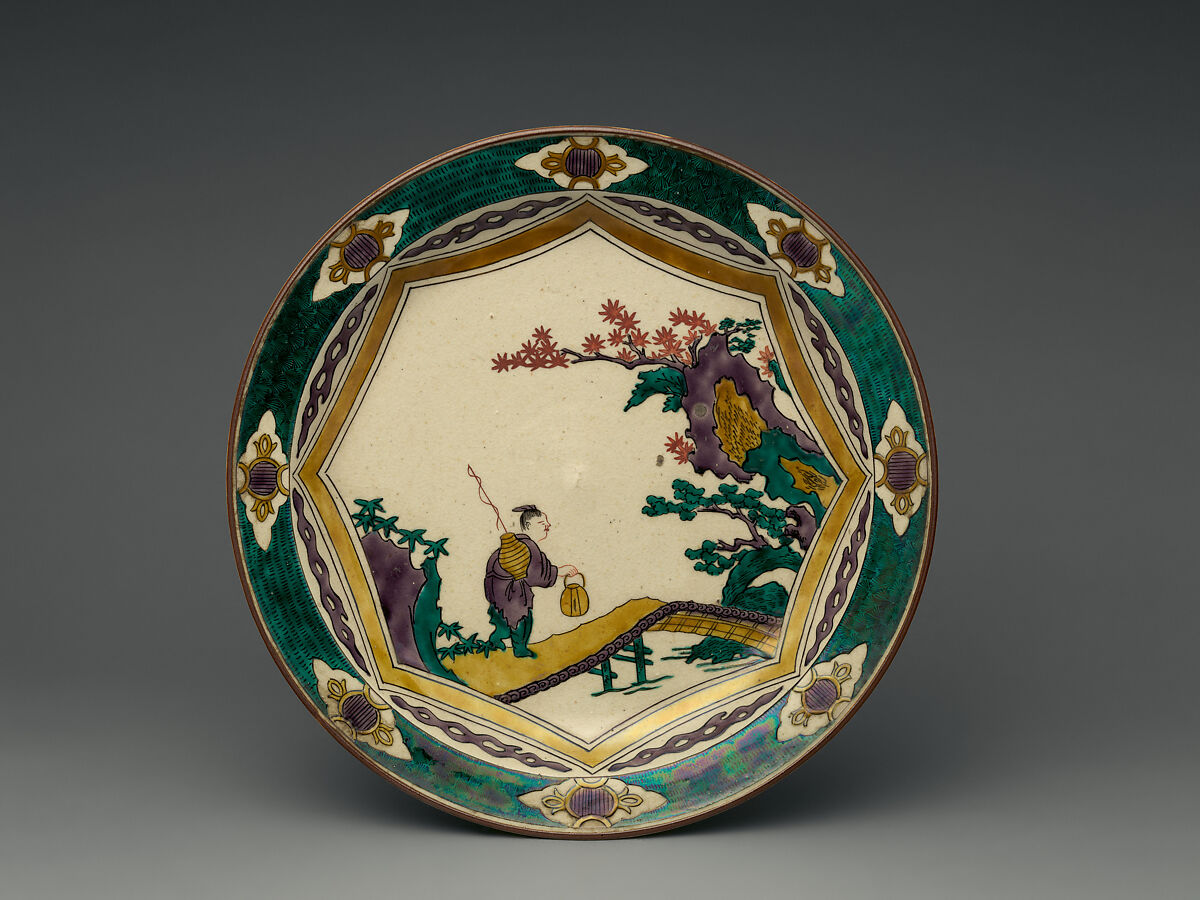
Ko-Kutani’s visual range was genuinely wide. Its motifs drew on flowers, birds, landscapes, and figures, executed in painting styles influenced by the Kanō school, the Tosa school, decorative Yamato-e conventions, and even late-Ming Chinese woodblock print aesthetics — a mixture that suggests access to a broad range of pictorial references, not a single narrow workshop tradition. Two broad decorative approaches are generally distinguished within Ko-Kutani: work using the full gosai (five-color) palette described below, and ao-de (“green style”), which omits red entirely and densely covers the surface with color in a technique called nuritsume-de (“fill-in style”) — a noticeably different visual effect from the more open, accented compositions typical of five-color work.
Because production was so limited and the kiln’s own history so poorly documented, genuine Ko-Kutani pieces are exceptionally rare today, occupying a tier closer to museum-grade historical artifact than typical antique-market inventory.
A Century of Silence, Then a Deliberate Revival
For roughly a hundred years after Ko-Kutani’s kilns fell silent, Imari ware effectively had Japan’s porcelain market to itself. Interest in reviving Kutani only began stirring in the late Edo period, after Seto’s own porcelain industry succeeded, prompting attempts at new kilns in Kaga — Kasugayama-yaki and Wakasugi-yaki among them — that demonstrated regional porcelain production was viable again.
The figure most associated with actually reviving Kutani specifically, rather than just porcelain production generally, is Yoshidaya Denemon, a wealthy merchant from the castle town of Daishōji. Deeply drawn to Ko-Kutani’s distinctive artistry — particularly its ao-de style — he invested heavily from his own funds and, in 1823 or 1824, built a climbing kiln directly beside the ruins of the original Ko-Kutani kiln in Kutani village. What his workshop, known as Yoshidaya kiln, produced genuinely rivaled Ko-Kutani in artistry and quality. It also lost money steadily, because Yoshidaya prioritized artistic fidelity over anything resembling commercial viability. The kiln relocated to the more accessible Yamashiro Onsen in an attempt to salvage its finances, and closed anyway, around 1831 — roughly seven years after it began.
Yoshidaya’s kiln wasn’t the only significant revival-era workshop, and the years following it are generally grouped together as Saikō-Kutani (“revived Kutani”):
Miyamotoya kiln, where the painter Iidaya Hachirōemon developed a distinctive fine red-line technique known as akae saimyōga (“fine red-picture painting”) — covering a piece’s surface in dense, minutely detailed red linework, a style different enough from both gosai and ao-de to be recognized as its own approach, sometimes called Hachirō-de after him.
Eiraku kiln, where Eiraku Wazen introduced kinrande — gold-brocade overglaze decoration — adding a further, distinctly different decorative vocabulary to the growing range of what “Kutani” could mean.
Kutani Shōza, working across the late Edo and Meiji periods, who developed saishoku kinrande, combining imported Western pigments with fine detailed painting and gold. His workshop’s output was significant enough to drive Kutani ware’s international breakout: after Japan’s participation in the 1873 Vienna World’s Exposition, Kutani porcelain became known internationally under the name “Japan Kutani,” and substantial quantities were exported abroad — the same kind of international visibility moment that shaped Arita’s own export history two centuries earlier, arriving for Kutani considerably later and through a different mechanism.
The Five Colors, and the Style Without Red
Kutani gosai (“Kutani five colors”) — red, yellow, green, purple, and dark blue (kon-jō) — is the palette most associated with the Kutani name generally, typically used in compositions that leave meaningful unpainted space around confidently rendered motifs.
Ao-de, by contrast, deliberately excludes red, working instead in green, yellow, purple, and dark blue, applied densely enough to cover most or all of a piece’s visible surface — the nuritsume-de fill technique mentioned above. This isn’t simply “gosai minus one color.” It produces a genuinely different visual effect: heavier, more saturated, less concerned with negative space, and specifically the style Yoshidaya’s revival kiln was most devoted to reconstructing.
Learning to tell these two approaches apart on sight is one of the more useful pieces of practical vocabulary for evaluating a Kutani piece, since a work described simply as “Kutani-style” could reasonably mean either.
Kutani Today
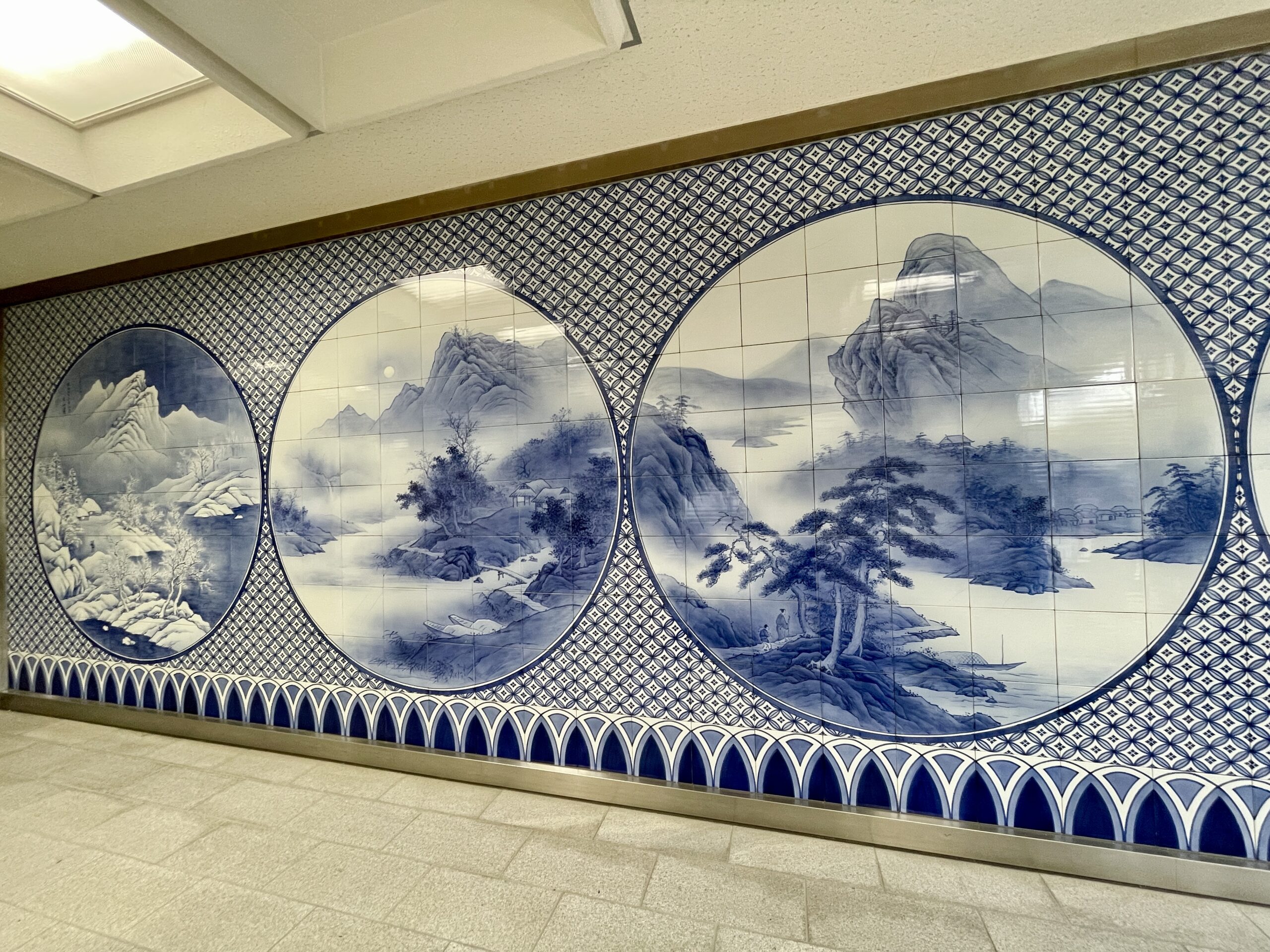
Modern Kutani production continues concentrated in the Nomi area of Ishikawa Prefecture, carrying forward techniques with direct lines back to the revival period — Saida Dōkai’s fine red-line painting technique in particular took root there, and Kutani Shōza’s move toward techniques suited to larger-scale production shaped how the region’s workshops have operated since. Contemporary workshops such as Kutani Bitōen (founded 1914) and artists working in the saiyū (colored-glaze) tradition associated with the Tokuda Yasokichi name represent the range from painterly historical technique to more studio-refined, individually signed contemporary work.
A Collector’s Guide to Kutani
A few practical points worth keeping in mind when evaluating a piece:
“Kutani” spans roughly 370 years and at least four genuinely distinct production periods — Ko-Kutani (mid-to-late 17th century), the century of silence in between, Saikō-Kutani’s several distinct revival workshops (early-to-mid 19th century), and everything produced since. A piece described only as “Kutani” without further context could plausibly belong to any of these, and the value, rarity, and appropriate price expectations differ enormously between them.
Genuine Ko-Kutani is exceptionally rare and belongs in a different evidentiary category than later Kutani ware. Given a fifty-year production window that ended over three centuries ago, any Ko-Kutani attribution deserves the highest level of scrutiny in this entire guide — museum or major-auction-level documentation, not general stylistic resemblance.
“Ko-Kutani” as a place-of-origin claim deserves particular caution. Given the ongoing scholarly dispute over whether much Ko-Kutani ware was actually produced in Kutani village versus at Hizen kilns near Arita, a piece described as Ko-Kutani is safest understood as a claim about style and period first, and a claim about specific production location second — any listing presenting the Kutani-village origin as beyond dispute is simplifying a genuinely open question.
Gosai and ao-de are different claims, and a piece should be described accurately as one or the other. A “five-color Kutani” description applied to a piece using ao-de’s red-free, densely filled palette (or vice versa) is a meaningful inaccuracy, not a minor rounding error — the two styles trace back to different historical impulses within the revival period.
Don’t let “why Ko-Kutani closed” theories get stated as settled fact. Various theories circulate — financial trouble, a shift in domain policy, competition from Arita — but the honest, well-sourced position is that the cause remains genuinely unknown. Treat any confident single explanation offered for the closure with the same caution this guide recommends for any other unverified historical claim.
Kutani Shōza’s export-era work opened the international market, but “export era” and “high artistic tier” aren’t automatically the same claim. The Vienna Exposition breakthrough drove real volume; evaluating an individual piece from this period still requires looking at its actual painting quality and condition rather than assuming export-period Kutani is uniformly museum-grade simply because of its historical significance.
Why Kutani Rewards Curiosity About Gaps
Every other tradition in this guide can be read, at least in outline, as a continuous story — a kiln started, and kept going, sometimes struggling, sometimes reviving, but rarely disappearing entirely. Kutani’s history has an actual hole in it: fifty years of real accomplishment, then genuine silence, then people a century later trying to reconstruct what had been lost from the evidence that survived. That gap isn’t a flaw in the record. It’s part of what gives Kutani ware its particular character — a tradition that had to be deliberately re-imagined once, by people working hard to be faithful to something they could no longer simply ask a living teacher about.
About HOJO Japanese Ceramic
HOJO Japanese Ceramics is based in Tobe Town, Ehime Prefecture, one of Japan’s historic pottery regions.
We research, curate, and share authentic Japanese ceramics with collectors around the world.
Explore our curated collection in the HOJO Etsy Shop.