Every tradition covered so far in this series — Bizen, Hagi, Raku — is stoneware: fired clay, opaque, earth-toned by nature. Arita is where Japan learned to make something else entirely. Hold a piece of true Arita porcelain up to a window and light passes through its edges. That translucence isn’t a stylistic choice. It’s a different material, discovered in a specific place, at a specific moment, by a specific person — and it changed what Japanese ceramics could be taken for by the rest of the world.
- The Discovery That Started It
- Early Imari: Porcelain’s First Steps
- The Breakthrough: Color Arrives
- Three Styles Worth Telling Apart
- The Kakiemon Lineage: Innovation, Interruption, Revival
- Reading Arita’s Export History
- Typical Forms
- A Collector’s Guide to Arita
- Why Arita Rewards a Different Kind of Attention
- About HOJO Japanese Ceramic
The Discovery That Started It
Until the early seventeenth century, every ceramic tradition in Japan was stoneware or earthenware — dense, opaque, fired from clay. Porcelain, translucent and stone-hard, was something Japan imported from China, not something it made. That changed because of a Korean potter named Yi Sam-pyeong, who had been brought to Japan following Toyotomi Hideyoshi’s Korean campaigns of the 1590s, in the retinue of Nabeshima Naoshige, the daimyo who ruled Hizen province, including Arita.
In 1616, Yi — who took the Japanese name Kanagae Sanbee and appears as a real, documented figure in the temple records of Arita’s Ryūsenji — discovered deposits of usable porcelain stone at Izumiyama, on the eastern edge of Arita. He opened the Tengudani kiln nearby and fired what’s generally credited as Japan’s first true white porcelain. Arita still honors him as its tōso (“ceramic ancestor”), with a shrine, Sueyama Jinja, dedicated to him as its enshrined deity — a level of civic memory unusual even among Japan’s ceramic traditions.
Early Imari: Porcelain’s First Steps
Porcelain made in Arita between roughly the 1610s and 1650s is known as Shoki-Imari (“Early Imari”) — a name that points to something worth clarifying immediately: Arita ware and Imari ware are, historically, the same porcelain, named differently depending on which end of its journey you’re describing. Arita is where it was made; Imari was the nearby port from which it shipped, both domestically and eventually to Europe, and “Imari” became the name the outside world knew it by for centuries.
Early Imari porcelain leaned heavily on Chinese ceramic influence, decorated exclusively in cobalt-blue underglaze (sometsuke) — no color yet. Production used a technique called namagake, applying glaze without an initial bisque firing, which gave early pieces a somewhat thick, soft-edged quality and simple, unfussy motifs of plants and birds. It’s an approachable, almost rustic style precisely because the technical ambitions of later Arita ware hadn’t developed yet.
The Breakthrough: Color Arrives
Everything changed in the 1640s. Sakaida Kishōemon, a Kyushu potter, had been experimenting since 1643 with akae — overglaze enamel decoration, applying colored pigments on top of an already-fired glaze rather than painting only in blue beneath it. Around 1647, after considerable difficulty, he succeeded, and took the name by which his descendants have worked ever since: Sakaida Kakiemon.
The innovation mattered enormously. Japanese ceramics up to this point had been effectively monochrome under glaze. Overglaze enamel opened the door to real color — reds, greens, yellows, blues applied in fine, controlled detail — and it’s the technical foundation underneath everything that makes Arita’s most famous later styles recognizable.
Three Styles Worth Telling Apart
By the height of the Edo period, Arita ware had differentiated into three broad styles, each with a distinct visual identity and market:
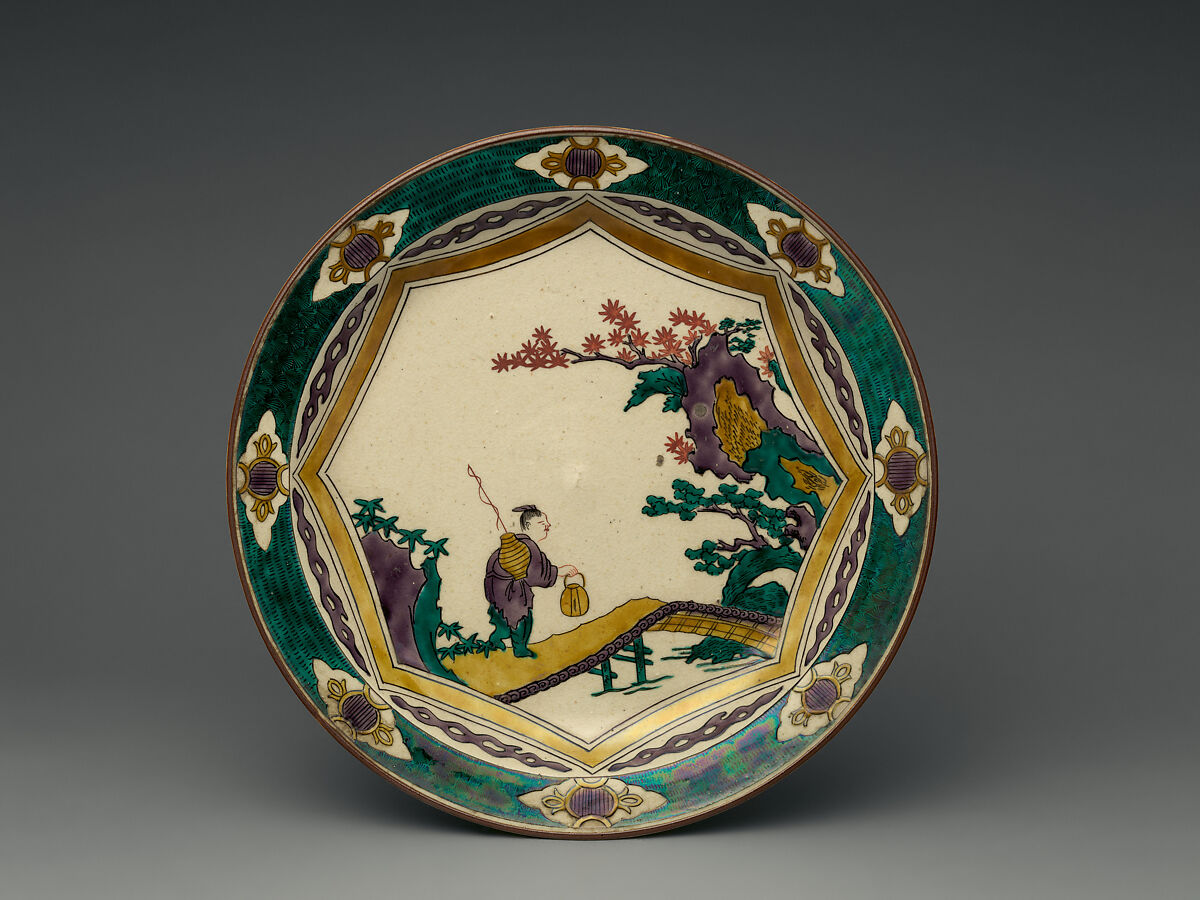
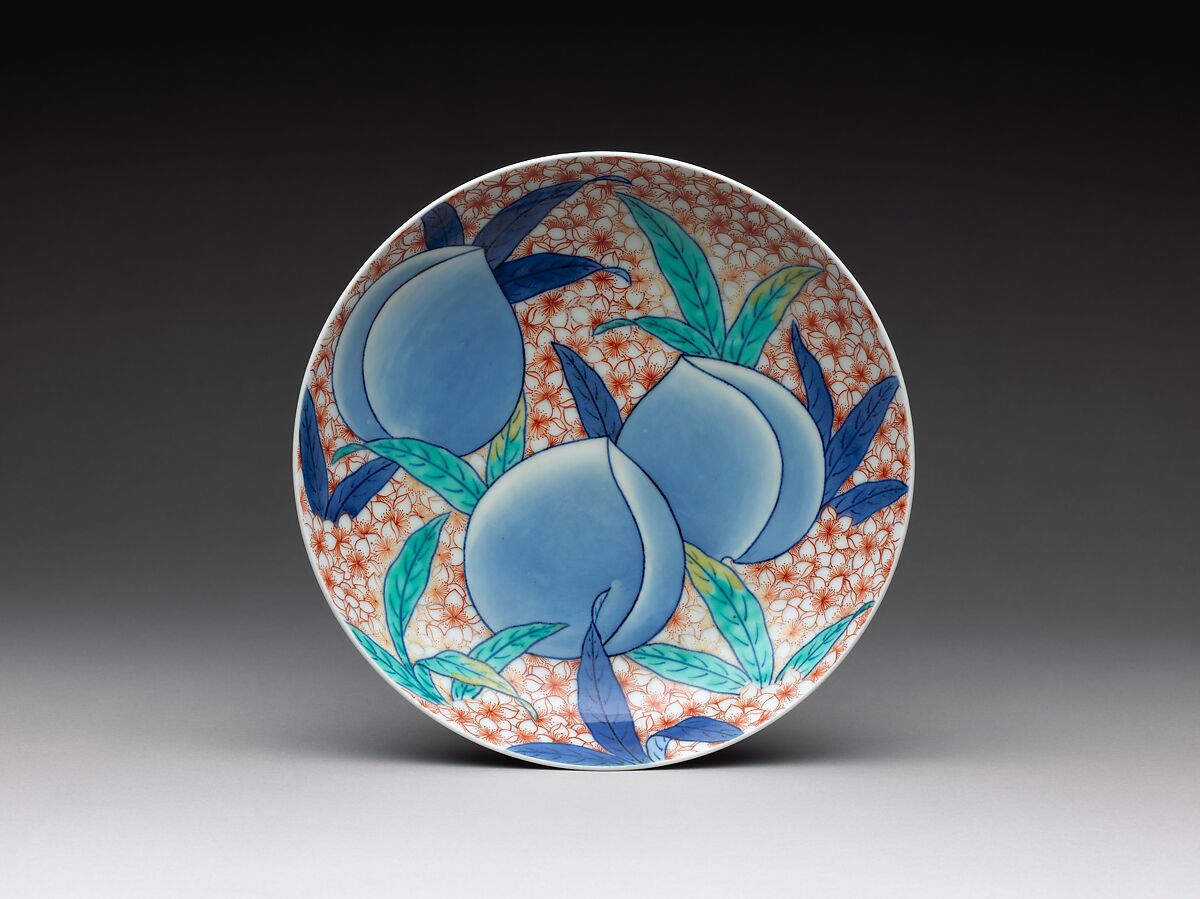
Ko-Imari (“old Imari”) is the broadest of the three, generally used as an umbrella term for Arita porcelain outside the Kakiemon and Nabeshima traditions specifically — vigorous, often densely patterned ware in blue-and-white or combined underglaze-and-overglaze color, produced across a wide range of quality levels for both domestic use and export.
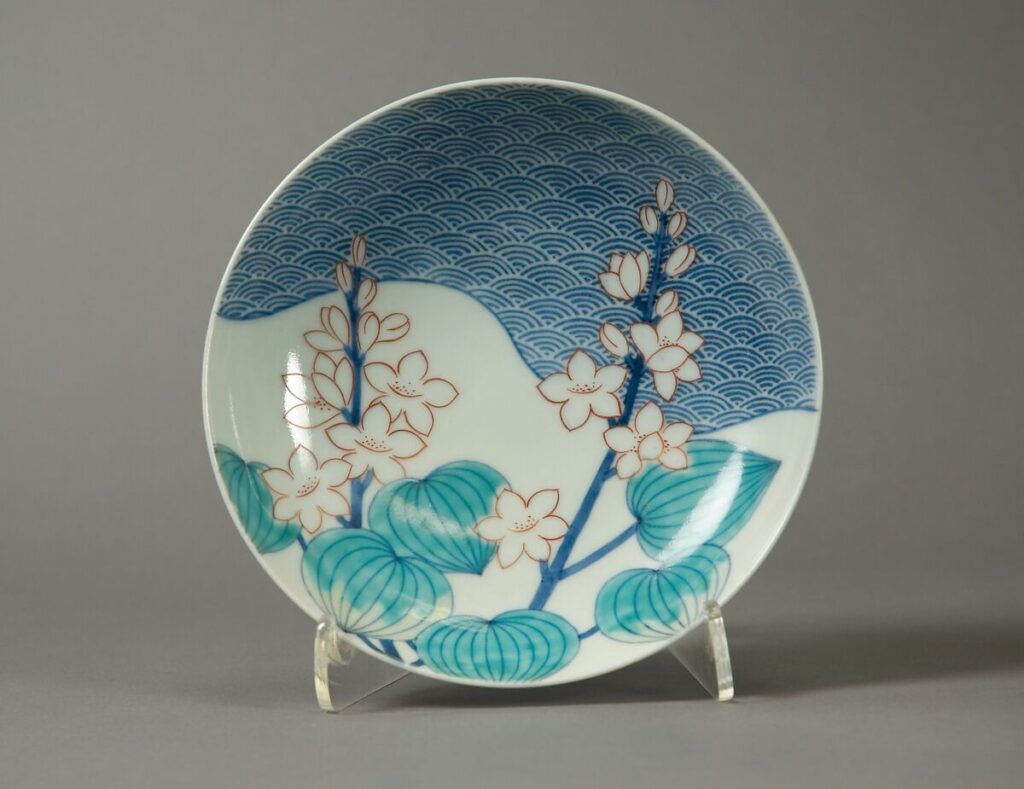
Kakiemon style is defined by nigoshide (濁手), a warm, milky-white porcelain body developed specifically as an ideal canvas for restrained, asymmetric overglaze painting — deliberately leaving generous unpainted space around carefully placed motifs of birds, flowers, and foliage, in a compositional restraint that stands in real contrast to more densely patterned export ware.
Nabeshima style, by contrast, was never made for sale at all in its original context. Produced at a kiln under the direct control of the Nabeshima domain specifically to supply gifts for the shogunate and other feudal domains, it represents Arita porcelain at its most technically exacting — a controlled, closed production system with no commercial pressure to cut corners, which shows in the precision of its painting and potting.
The Kakiemon Lineage: Innovation, Interruption, Revival
The Kakiemon workshop’s history is genuinely eventful enough to be worth following generation by generation, because it isn’t a story of simple, unbroken continuity — it includes a real interruption and a deliberate revival, which matters for how pieces from different periods should be understood and valued.
Export via the Dutch East India Company (VOC) began in earnest around the 1660s, and European demand for Kakiemon-style porcelain grew intense enough that by around 1720, the German Meissen manufactory — Europe’s own first successful hard-paste porcelain maker — was directly copying Kakiemon’s white body and overglaze technique. European enthusiasm cooled by around 1750, and the domestic market shifted too.
The middle Kakiemon generations, roughly the fifth through seventh heads across about ninety years spanning the late seventeenth into the eighteenth century, had a genuinely uneven record. The fifth-generation head’s work was apparently not up to standard, leading the Nabeshima domain to suspend its standing orders in 1685. The sixth generation, aided by a skilled uncle, Jūemon, successfully diversified into flower vessels, incense burners, and other forms at a high standard, and is remembered as a “restoration ancestor” for stabilizing the workshop; a 1724 petition to the domain partially restored special commissions. But broader economic pressure — declining VOC export volume and domestic recession — eventually caused the nigoshide technique itself to lapse entirely during the eighteenth century. It wasn’t revived until the twelfth and thirteenth generations, working together as father and son, brought it back.
The workshop continues today under its fifteenth-generation head, who took the name in 2014. That’s roughly three hundred seventy years of continuous family name, interrupted once at the level of a specific technique, and deliberately restored — a more complicated and, arguably, more interesting story than a simple unbroken lineage would be.
Reading Arita’s Export History
Between about 1659 and the mid-1680s, hundreds of thousands of pieces of Arita porcelain shipped out of Imari port, reaching European collections in numbers substantial enough to visibly influence European decorative art. European aristocrats competed to acquire it, and European workshops — Meissen most successfully — produced their own copies once they’d reverse-engineered enough of the technique to attempt it. Pieces bearing the mark of the VOC (a stylized monogram) were made specifically for this export trade, and surviving examples are a direct, physical link to a documented global trade network rather than simply old ceramics.
Typical Forms
Arita’s output ranges from densely decorated large export plates and vases — the forms most associated with the VOC trade and the ones most likely to turn up in Western museum collections — to more intimate objects: small dishes, sake vessels, and the incense burners and flower vessels the Kakiemon workshop diversified into during its sixth-generation recovery. Nabeshima ware, given its gift-only original purpose, tends toward finely potted plates and small vessels rather than large-scale export ware.
A Collector’s Guide to Arita
A few practical points worth keeping in mind when evaluating a piece:
“Imari” and “Arita” describe the same porcelain from two different angles, not two different wares. A piece labeled either way isn’t automatically more or less authentic than the other — the distinction is about production location versus historical shipping point, and modern usage has additionally shifted to distinguish porcelain actually made in Arita town from porcelain made in present-day Imari city, which adds a layer worth clarifying with any specific piece rather than assuming.
Nigoshide authenticity is worth extra caution, on the workshop’s own advice. The Kakiemon workshop’s own current website explicitly warns that a substantial number of imitation nigoshide pieces circulate in the market, and advises buyers to be careful before purchasing. That’s about as direct a caution as a collector could ask for, and it applies with particular force to anything attributed specifically to the Kakiemon name rather than described more generally as “Kakiemon-style.”
A VOC mark indicates export-market production, not automatically higher quality. These pieces are historically significant and often finely made, but the mark itself confirms a trade destination, not a specific style tier — don’t let it substitute for actually evaluating the piece.
Nabeshima ware’s original context matters for how rare it actually is. Because it was never sold commercially in its own period, genuine Edo-period Nabeshima ware on today’s market represents pieces that left a closed gift-giving system, not surplus commercial stock — a meaningfully different rarity claim than simply “old and well-made.”
The Kakiemon lineage’s mid-period interruption is a fact worth knowing precisely, the same way Hagi’s 1774 lineage break is worth knowing precisely: continuous family name since the seventeenth century is genuine, but “continuous production of the nigoshide technique specifically” is a narrower and less accurate claim, true only up to a point in the eighteenth century and again from the twelfth-thirteenth generation onward.
Why Arita Rewards a Different Kind of Attention
Where Bizen and Hagi ask you to read the marks fire and time leave on unglazed or thinly glazed stoneware, Arita asks you to read craftsmanship and documented history instead — a specific discovery, a specific technical breakthrough, a specific trade route to specific European collections, a specific family lineage with a real interruption in its most famous technique. It’s the one tradition in this guide where “Japanese ceramics” and “a global luxury export good, four centuries running” were, almost from the beginning, the same object.
About HOJO Japanese Ceramic
HOJO Japanese Ceramics is based in Tobe Town, Ehime Prefecture, one of Japan’s historic pottery regions.
We research, curate, and share authentic Japanese ceramics with collectors around the world.
Explore our curated collection in the HOJO Etsy Shop.